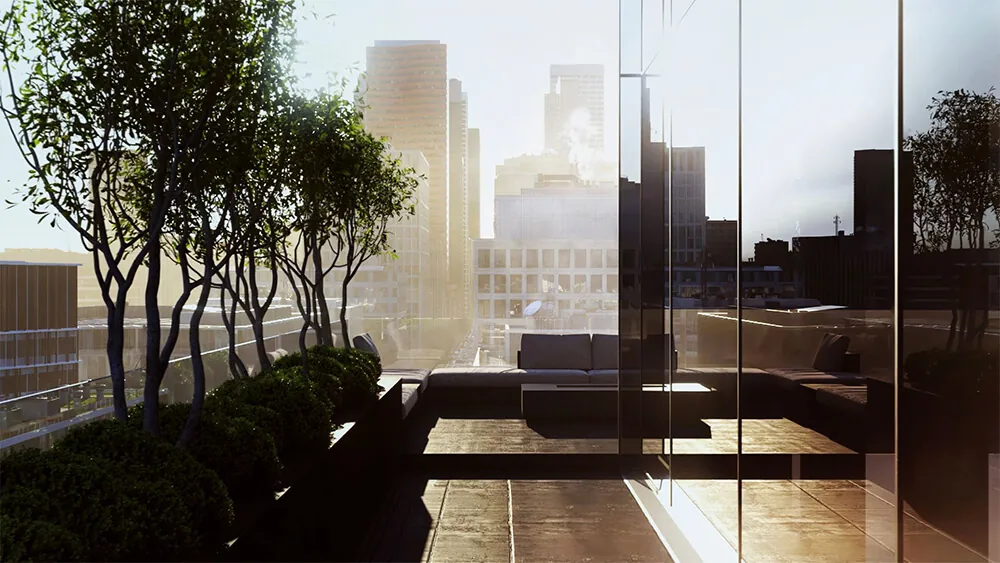
Penthouse units represent a specific problem in real estate marketing: they're the highest-priced units in any development, they're always sold before construction is complete, and they're purchased by buyers who have seen many properties and have highly refined expectations. A penthouse render isn't just showing a floor plan and materials — it's communicating a lifestyle, a city relationship, and a quality of experience that justifies a price premium over everything below it.
The render quality expectations for penthouse marketing are categorically different from standard unit visualization. Developers who apply the same render specifications to their penthouses as to their one-bedroom units consistently underperform on their highest-value inventory. Penthouse renders require a specific brief, a higher production investment, and a visualization approach that captures the qualities that distinguish top-floor living.
The View: The Dominant Penthouse Design Feature
In any high-rise development, the penthouse's primary asset is elevation — the view from the top floor is fundamentally different from the view five floors below. The render needs to show this difference compellingly. A penthouse living room render where the windows show a generic blue sky misses the entire point of the property.
For Los Angeles penthouses, the city view is often one of three types: the west-facing Pacific Ocean and Malibu coastline view; the north-facing view toward the Santa Monica Mountains and Hollywood Hills; or the panoramic downtown LA and basin view available from towers in Century City, downtown, or the Wilshire corridor. Each of these views has a specific character — the colors of the Pacific at different times of day, the quality of light on the mountain ranges, the density and pattern of the LA basin at dusk — and the render needs to show the actual view from that specific unit position, not a generic urban backdrop.
This means penthouse renders require the actual GPS coordinates of the building, the floor level of the penthouse, and the compass bearing of each facade. With this information, the studio can accurately calibrate the view backdrop — the position of the ocean horizon, the direction the sun sets, the specific cityscape visible from that location. For buyers committing to $5M–$20M+ for a penthouse, the view accuracy is not a detail — it's the primary justification for the purchase.
Sky Terraces and Outdoor Spaces
Penthouse units at the luxury tier typically include private outdoor space — a sky terrace, roof deck, or private rooftop. These outdoor spaces are as important as the interior rooms in the marketing narrative, and they require dedicated renders that show the outdoor experience.
Sky terrace renders have specific requirements: the view from the terrace needs to show the city or landscape at the correct elevation and bearing; the outdoor furniture and landscaping need to be at the quality level appropriate for the building's market tier; and the time of day should typically be either golden hour or dusk, when the city lights and sky colors create the most compelling atmospheric conditions. A dusk terrace render with the LA basin sparkling below and the sky in gradient from orange to deep blue is a powerful single images in luxury residential marketing.
For penthouse buildings in LA, the outdoor space render is often the image that drives the initial inquiry. It shows potential buyers the life they're buying rather than the apartment — the Sunday morning coffee with the Pacific as backdrop, the evening entertainment with downtown as the view. This narrative quality matters.
Ultra-Luxury Interior Specifications
Penthouse units carry ultra-luxury material specifications that need to be accurately rendered: natural stone (marble, quartzite, travertine) on floors, counters, and feature walls; custom kitchen systems (Bulthaup, Boffi, SieMatic) with specific hardware finishes; floor-to-ceiling glazing systems with slim profiles; custom joinery in primary and closet spaces; and signature fixtures and lighting design.
Each of these materials behaves differently in render and requires specific handling. Natural stone needs to show its veining and variation — a generic white marble texture is immediately identifiable as a placeholder. Custom kitchen systems need accurate panel geometry and the correct metallic finish (brushed nickel, matte black, polished bronze). Glazing systems need to show the thin profile of the frame, the reflection quality of the glass, and the relationship between interior and exterior light.
For penthouse renders, material specification accuracy is non-negotiable. Buyers at this price tier will bring interior designers who know exactly what a particular stone looks like, and a render that approximates the specification undermines confidence in both the visualization and the building team. The brief for a penthouse render should include the actual material specifications — the stone supplier and slab reference, the kitchen system specification, the hardware finishes — not general categories. Our interior rendering service handles ultra-luxury material specifications with the accuracy this tier requires.
The Penthouse Render Package
A standard penthouse marketing render package typically includes:
- Primary living space with city view — the main living room or great room with full-height glazing showing the view. Typically rendered at both dusk and daytime to provide two hero images.
- Sky terrace or roof deck — the primary outdoor space at dusk or golden hour. Often the most impactful single image in the package.
- Kitchen — showing the full luxury kitchen specification with island, custom cabinetry, and appliances.
- Primary bedroom suite — the master bedroom showing the wake-up view, luxury bed specification, and en-suite bath glimpse or full bath render.
- Primary bathroom — freestanding tub, shower, stone surfaces, and the view if applicable (corner penthouses with bedroom/bathroom views).
- Study or secondary living space — for multi-level penthouses, a den, study, or secondary entertaining space that demonstrates the full footprint.
For buildings with a penthouse that's a key sales driver, some developers commission a twilight exterior render showing the penthouse floor illuminated against the nighttime skyline — the building as it looks from the street, with the penthouse glowing at the top. This exterior render communicates the penthouse's position and scale from the ground-level buyer perspective.
A complete penthouse render package of 6–8 views typically runs $5,000–$12,000 at the quality level appropriate for luxury residential marketing. Full pricing details are on our pricing page.
Photography vs. Rendering for Penthouse Marketing
When the building is complete, photography of the actual penthouse is the gold standard for marketing. But most penthouses are sold before the building is complete — sometimes years before — and even after completion, the ideal marketing photography may not be available at the right time of day, season, or weather conditions.
Renders allow the marketing campaign to launch months before the building is ready for photography, using imagery that shows the penthouse at its absolute best — optimal weather, optimal city light conditions, fully furnished and styled. For a detailed comparison of these approaches, see our article on CGI vs. traditional photography.
For high-rise penthouse marketing specifically, the view render is often better than photography can achieve: the camera position in the render can be placed at the exact right height within the room, the city view can be shown in optimal conditions, and the interior-to-exterior light balance can be perfected in ways that even the best architectural photographers struggle with in a real building.
Marketing a Penthouse Unit?
Share your floor plans and material specifications — we'll scope a penthouse render package with city-accurate views within 2 hours.
Request a Penthouse Quote