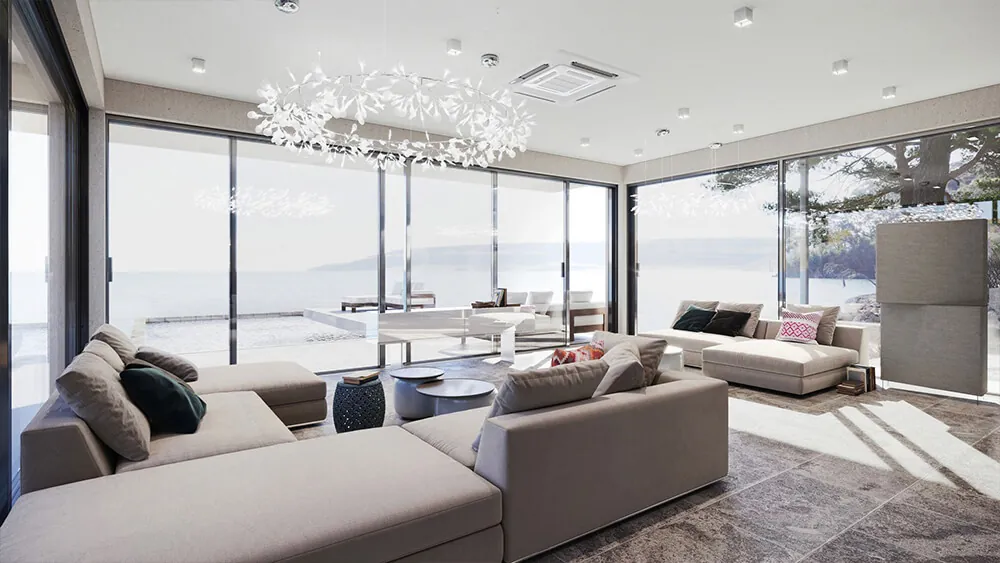
Condo pre-sales is the most demanding application of architectural rendering because the buyer is making one of the largest financial decisions of their life based entirely on images of something that doesn't exist yet. A buyer committing a $200,000 deposit on a unit that won't be delivered for three years is not buying an apartment — they're buying the rendering, the floor plan, the virtual tour, and the brand experience the visualization creates. The render is the product.
This changes what "good" means in visualization. It's not about photorealism as an end in itself. It's about whether each image resolves the specific question standing between a buyer and a signed purchase agreement. Getting that right is a strategy exercise — and this guide covers how to approach it.
Why pre-sales velocity is a financial variable, not just a marketing metric
Most developers understand the marketing value of renders. Fewer think explicitly about the financial mechanics that make pre-sales visualization a critical path item rather than a discretionary upgrade.
Construction lenders typically require 30–50% pre-sales as a condition of the construction loan. This threshold must be reached before the loan fully draws — meaning before you can build the project you're selling. The speed at which you reach that threshold determines your construction start date, your carrying costs, and your exposure to market timing risk. A pre-sales campaign that takes 12 months to hit 40% sold is structurally more expensive than one that hits 40% in 6 months, even before you factor in the revenue difference from higher prices achieved during a stronger launch.
Projects that launch with exceptional visualization packages hit their pre-sale thresholds faster. In Miami, the Ritz-Carlton North Bay Village closed over $1 billion in pre-sales before a single floor was poured. In Manhattan, 520 Fifth Avenue became the fastest-selling condominium launch of 2024 with more than half its units committed before vertical construction began. Both campaigns were anchored by comprehensive visualization packages — not just hero renders, but the full system of assets that moved buyers through the decision sequence from first click to signed agreement.
The five visualization assets a condo pre-sales package needs
A well-structured pre-sales package covers five asset types, each serving a specific function in the buyer's decision process:
Exterior hero render — the primary marketing image, typically the building from a slightly elevated street-level position at golden hour or dusk. This image anchors every channel: the project website, broker materials, listing platforms, press releases, and outdoor advertising. It establishes the visual identity of the development and sets the quality standard for everything that follows. A building that looks credible and aspirational from the street converts browser traffic into registration registrations. One that looks generic loses buyers before they reach the floor plans.
Unit type interiors — at minimum, one interior render per bedroom count showing the kitchen/living space and the primary feature space (master bedroom for family-oriented units, the view room for view-facing units). For a building with studios, one-bedrooms, two-bedrooms, and penthouses, that's 4–5 interior renders at the minimum. High-demand unit types — typically corner two-bedrooms and penthouses — warrant additional views. Interior renders are the images buyers spend the most time with, and they're the primary driver of the emotional conviction that leads to a signed agreement.
Amenity renders — the amenity program is a competitive differentiator in urban condo markets. Pool deck, lobby, fitness center, rooftop lounge — every amenity that differentiates the building from nearby competitors should be rendered. These images appear in the sales suite, on the project website, and in all branded content. A single poorly rendered amenity can undermine the positioning of the entire development; a well-rendered amenity sequence justifies a pricing premium over comparables that lack a clear lifestyle statement.
3D floor plans — for every unit type, a top-down or isometric 3D floor plan showing the layout, proportions, and furniture fit. Buyers use floor plans to understand flow, storage, and whether their existing furniture will work in the space. 3D floor plans are the second-most-used asset in the sales process after interior renders — buyers return to them repeatedly as they narrow their decision to a specific unit and floor.
View simulation renders — for units selling on the strength of their view, renders showing the actual view from the unit's floor and orientation. Produced by compositing the building's accurate position with real aerial or satellite imagery of the surroundings, these renders directly address the buyer's most specific question: what will I actually see when I'm standing in my living room on the 24th floor, facing southwest? View simulations are discussed in detail in the section below.
The deposit sequence: matching assets to the sales funnel
Condo pre-sales follows a specific decision sequence that most articles about rendering never address: the buyer doesn't make a single decision to purchase. They make a series of progressively committed decisions — registration, VIP preview attendance, reservation deposit, binding purchase agreement — and they need different visual information at each stage.

The visualization package should be deployed in sequence to match this funnel:
- Registration phase (6–12 months before sales launch). Release the exterior hero render publicly to drive registrations. This is the image that appears on the teaser website, in social media ads, and on the construction hoarding. Its job is to generate registration intent — buyers who want to be contacted when the building launches. The exterior render alone is sufficient for this stage; releasing interior renders too early removes urgency from the VIP preview event.
- VIP preview (4–6 weeks before public launch). Registered buyers get first access to the full visualization package — interior renders, amenity renders, 3D floor plans, and view simulations for premium units. The VIP preview is where the majority of early deposits are collected. Having the complete package ready for this event is critical. Buyers who register early and arrive at a VIP preview to find the visualization package incomplete — a few renderings, no floor plans, no amenity views — convert at significantly lower rates than those who can see the full picture.
- Public sales launch. Full package goes live across all channels simultaneously. Buyers who didn't commit at the VIP preview now see that early units have been reserved, adding urgency. The visualization system — website, brochure, sales gallery displays, digital suite — must function as a complete sales tool without requiring a sales agent to explain the gaps.
- Sales period. Release new angles, additional unit type views, and construction progress composites as marketing momentum requires. For projects with extended sales periods, refreshing visualization assets with additional content maintains buyer engagement.
View simulation and floor premium pricing
View simulation renders deserve specific attention because they do something no other asset in the pre-sales package does: they allow developers to justify per-floor price differentials with visual evidence rather than just stating a number.
Most condo towers price units higher on upper floors — typically $1,000–$3,000 per floor per unit in urban high-rise markets. The view simulation render makes that premium tangible. A buyer choosing between floor 12 and floor 22 can see exactly what they're paying $30,000 more for. In a sales environment where the buyer cannot visit the actual unit, this visualization transforms an abstract premium into a concrete, evaluatable choice.
View simulations also serve a secondary function: they accelerate sales of the premium units that generate the most revenue. Corner units and high-floor units typically command 15–30% premiums over comparable lower-floor or interior units. Buyers of these units are making a specific bet on the view, and they need visual confirmation before committing. Projects with strong view simulation renders for their premium inventory consistently achieve faster absorption of high-value units than those that ask buyers to imagine the view from a floor plan and a compass direction.
Luxury tier: customization and upgrade renders
For projects with units priced above $1.5M, buyers expect to choose their finish selections, and the visualization package needs to support that. Customization renders show the same unit in two or three finish schemes — a lighter, more contemporary palette alongside a warmer, darker option, for example. These renders allow buyers to see the impact of their choices before finalizing selections, which reduces post-sale amendment requests and buyer uncertainty during the decision process.
For penthouses and signature units where buyers are making more extensive customizations — custom millwork, specific material selections, bespoke lighting design — a dedicated design consultation render showing those custom elements positions the developer as a genuine luxury provider and reinforces the premium pricing. Penthouse unit visualization has specific briefing requirements around view composition, ceiling height communication, and the indoor-outdoor transitions that define top-floor living. These renders are also among the most effective assets for generating earned media coverage of the development; press and social media accounts focused on luxury real estate respond readily to distinctive penthouse renders.
The digital sales suite
Modern condo pre-sales increasingly run through digital sales suites — interactive web environments where buyers can explore the building, filter available units by floor and type, view the relevant renders and floor plans, and schedule appointments. The visualization package needs to be briefed and produced with digital deployment in mind from the start.
Practical implications: renders should be produced at web-optimized resolution alongside print-quality versions; 3D floor plans need to be clearly differentiated by unit type and floor; and the amenity renders should feel visually cohesive with the exterior and interior views as part of a unified visual identity. Buyers who navigate a digital sales suite that looks like renders from three different studios — inconsistent lighting, inconsistent material palette, inconsistent post-processing — lose confidence in the project's coherence. Visual consistency is a signal of development quality.
Pricing and production timeline
| Asset | Price range | Notes |
|---|---|---|
| Exterior hero render | $999–$2,500 | Primary marketing asset; highest quality brief |
| Unit interior (per type) | $499–$1,000 | Package pricing when 4+ unit types |
| Amenity render (per space) | $599–$1,200 | Lobby, pool, fitness, rooftop, etc. |
| 3D floor plan (per type) | $349–$700 | All unit types; isometric or top-down |
| View simulation render | $599–$1,000 | Key floors and corner units |
| Full pre-sales package | $20,000–$50,000+ | Scales with unit count and typology variety |
A complete pre-sales package takes 4–6 weeks from a thorough brief to final deliverables. The brief should be initiated as early as design development stage — once the exterior facade, unit layouts, and amenity program are resolved, even if construction documents aren't complete. The goal is to have the full visualization package ready for the VIP preview event, not scrambling to complete renders while the sales campaign is already running.
What to send your studio for a pre-sales brief
The quality of the renders scales directly with the completeness of the documentation you provide. For a condo pre-sales package, the minimum required documentation is:
- Architectural drawings at whatever stage is available — design development or construction documents preferred
- Unit floor plans for every unit type with accurate dimensions confirmed
- Material and finish specifications per unit type (or finish scheme options for luxury projects)
- Amenity space plans with furniture and equipment layout indicated
- Site plan showing building position, surrounding context, and orientation
- Reference images for the design positioning and target lifestyle
- Floor heights for the units requiring view simulation renders
- A list of which units need view simulations and from which orientations
Our services cover the full condo pre-sales visualization stack — exterior rendering, interior rendering, aerial rendering, and 3D floor plans. For context on how the LA condo market is evolving and what buyer expectations look like heading into this cycle, see our overview of Los Angeles real estate development trends 2026. For a detailed scope and pricing estimate for your project, visit our rendering pricing page.
Planning a condo pre-sales campaign?
Send us your floor plans and project brief — we'll scope a visualization package within 2 hours.
Request a Free Estimate