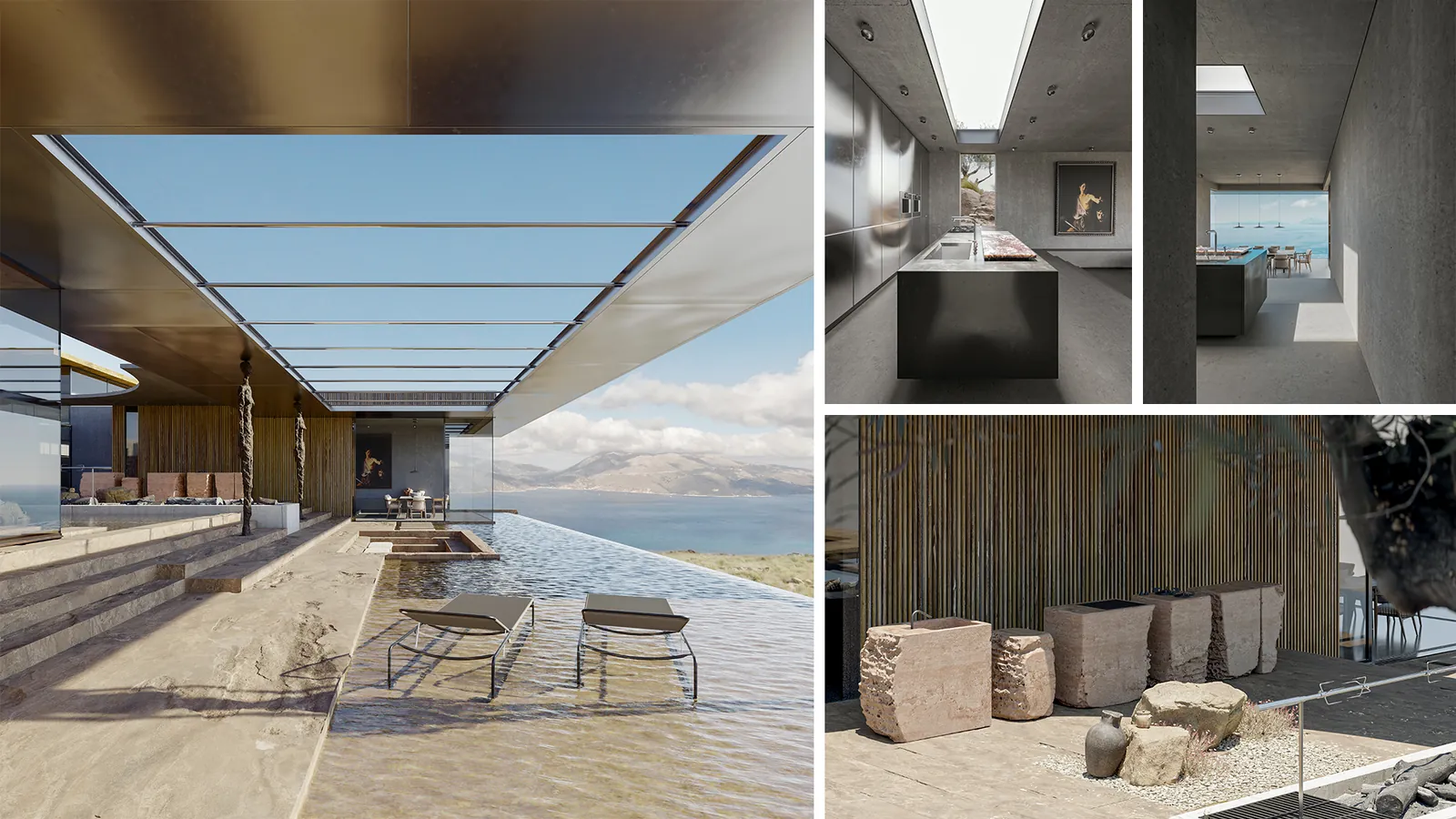
A professional architectural 3D rendering from a US studio costs $500–$3,500 per image for most residential and commercial projects. Simple residential exteriors sit closer to $500. Complex commercial views with full context modeling push past $3,000. Animation starts at $2,500 per finished minute.
Every pricing guide on the internet gives you those ranges — and then stops. What they rarely explain is why a specific project lands where it does, what's actually bundled into a quote versus what shows up as an extra, and when a cheaper provider will cost you more in the end. That's what this guide covers.
I've worked on architectural visualization projects across the full spectrum — single-family residential, high-rise commercial, multifamily pre-sales, and hospitality. The number one thing that surprises new clients isn't the headline rate. It's the scope items they didn't know to ask about.
2026 price ranges by render type
Rendering is priced per deliverable. Each camera angle, each floor plan, each animation minute is its own scope item. Here are current benchmarks for professional-quality work from established US studios — not offshore providers, not budget freelancers:
| Render Type | Price Range | Typical Turnaround | Main Cost Driver |
|---|---|---|---|
| Exterior — residential | $500–$1,500 | 3–5 days | Facade complexity, landscaping |
| Exterior — commercial | $1,000–$3,500+ | 4–7 days | Building scale, surrounding context, photomontage |
| Interior view | $500–$1,800 | 3–5 days | Furniture density, custom materials, lighting complexity |
| Aerial / bird's-eye view | $800–$2,500+ | 5–7 days | Context modeling — streets, terrain, neighboring buildings |
| 3D floor plan (per floor) | $300–$700 | 2–4 days | Floor area, furniture and finish detail level |
| Virtual staging (per space) | $300–$600 | 2–3 days | Number of rooms, furniture complexity |
| 360° virtual tour | $800–$2,500 | 5–8 days | Number of scenes, interactivity level |
| Animation (per minute) | $2,500–$8,000 | 1–3 weeks | Render time, camera path complexity, scene changes |
These reflect standard-quality work delivered on a normal timeline. Rush surcharges, unusual project complexity, or custom 3D modeling (when your drawings contain elements that don't exist in any asset library) can push numbers beyond these ranges. Our pricing page shows how we structure quotes for each of these types.
What a rendering quote actually includes — and what it doesn't
When a studio sends you a quote, it usually bundles several items together — and omits others. Knowing the difference prevents scope creep surprises mid-project.
| Bundled in most quotes | Commonly charged as extras |
|---|---|
| 3D modeling from your supplied drawings | Custom 3D modeling — bespoke furniture, unusual cladding, or branded signage not in any asset library ($150–$600+ per item) |
| Materials and textures from the studio's library | Photomontage — compositing your building into a real site photo for planning submissions ($200–$500 per view) |
| Lighting setup and rendering | Extended context — fully modeling an entire city block rather than a simplified background |
| Post-production: color grading, atmosphere, entourage | Additional revision rounds beyond the included number ($100–$300 per round) |
| 3 revision rounds included | Rush processing — usually 20–50% on top of the standard rate |
| Final delivery in high-resolution JPG or PNG | Print-ready formats — TIFF or layered PSDs at some studios |
Ask any studio to walk through the quote line by line before you approve anything. A studio that can't itemize what's in scope and what's extra isn't one you want managing a deadline-driven project.
The 6 factors that actually drive your cost
Rendering studios price on scope. Understanding what determines scope lets you predict your estimate before you contact anyone — and negotiate intelligently when you do.
1. Number of views
The single biggest lever you control. Each camera angle is a separate deliverable. A two-view package and a twelve-view package from the same building are fundamentally different scopes. However, volume pricing means the per-view cost decreases as you add angles — studios can reuse the 3D model they've already built. Brief all your views together rather than ordering them incrementally. You'll typically save 15–25% per view on a multi-view package versus placing orders one at a time. If you're not sure how many to order, our guide on how many 3D renders you actually need breaks it down by project type.
2. Render type
Aerial views cost more than exteriors because they require modeling the surrounding context — neighboring buildings, streets, terrain, landscape features that extend well beyond your property line. Animation costs more than stills because every frame must be rendered individually. Interiors become expensive when the furnishing is dense, the materials are custom, and the lighting involves complex interactions between natural and artificial sources.
3. Project complexity and 3D modeling time
The render itself is fast. The 3D model is where the hours live. A simple box-shaped residential structure with standard cladding takes a fraction of the time to model compared to a building with complex geometry, parametric facades, or unusual structural expression. For complex commercial projects, 3D modeling can account for 50–65% of total production cost. Ambiguous or incomplete drawings compound this — the studio must make interpretive decisions, which generate revision requests when the client says "that's not what I meant."
4. Materials and furnishings
For interior renders especially, the specificity of your design brief drives cost. A complete furniture schedule with manufacturer references and finish specifications lets the studio work efficiently. A vague brief that asks the studio to develop the interior concept is effectively paying for design services on top of rendering. That's legitimate, but it's a different scope — and a different price.
5. Timeline
Standard turnarounds are built into a studio's production schedule. Rush requests require bumping your project to the front of the queue, which typically carries a 20–50% premium. If you have genuine timeline flexibility, say so. Studios will often pass the benefit back in pricing. The cheapest thing you can do is brief a project before you need it.
6. Output requirements
Resolution, file format, and licensing terms all affect price. A web-quality JPG for a listing page is different from a 4K TIFF for a billboard print run. If you need the renders for broad commercial use — advertising campaigns, developer branding — confirm that the studio's standard pricing covers that usage or budget for a licensing fee.
US studio vs. offshore provider vs. freelancer: an honest comparison
Most clients face a 40–60% headline price difference between US studios and offshore providers. Here's what actually differs:
| US Studio | Offshore Provider | Freelancer | |
|---|---|---|---|
| Typical price per exterior | $500–$1,500 | $200–$700 | $300–$900 |
| Quality consistency | High — team-reviewed output | Varies widely by vendor | Depends entirely on individual |
| Revision handling | Structured, predictable rounds | Often vague — scope creep common | Depends on freelancer's process |
| Communication overhead | Low — same timezone, clear process | High — time zone gaps, language barriers | Medium — single point of contact |
| Risk on deadline | Low — team absorbs capacity issues | Medium — limited visibility into production | High — single person, no backup |
| Best fit for | Investor decks, marketing, pre-sales, planning submissions | Early design visualization, internal reviews | Small residential projects, low-stakes use cases |
Offshore providers have improved significantly in the past five years and the best ones now deliver work that's genuinely competitive with US studios on quality. The risk isn't the quality ceiling — it's the variance. When an offshore job goes wrong, the time zone gap and communication friction means problems compound before they get resolved. For a presentation you're giving to investors next Tuesday, that's a meaningful risk.
I'd recommend offshore providers for early-stage design visualization where you're iterating quickly and the renders aren't going to investors or planning boards. For marketing materials, developer brochures, or any output with a hard deadline, work with a studio where you can pick up the phone.
How pricing changes by project stage
Most clients think of rendering as a single event. In practice, the renders that serve you well at schematic design are different from the ones you need at pre-sales — in scope, quality tier, and cost.
Schematic design stage: You need enough visual clarity to align with your client or design team on spatial concepts. Renders at this stage don't need final materials or furniture — a good "white box" render or a medium-quality exterior with placeholder finishes can serve the purpose at $300–$600 per view. Speed matters more than photorealism. Read more about white box rendering and when to use it.
Planning and permit submissions: Accuracy matters here — planning boards need to understand massing, materials, and relationship to the street. A credible photomontage or accurate exterior render runs $800–$2,000 per view for a commercial project. More about rendering for permit applications.
Pre-sales and investor presentations: This is where quality level translates directly into revenue. A render that makes a buyer say "I want to live in that apartment" works. One that makes them say "hm, I guess I can imagine it" doesn't. Budget $800–$2,500 per view for images that will close transactions. See how developers use visualization in 3D rendering for real estate marketing.
Marketing campaigns: Brochures, websites, outdoor advertising, and social media each have different format requirements. Budget for the full package — multiple views, floor plans, possibly animation — and negotiate a project rate rather than per-image pricing. Most studios offer meaningful discounts on packages above 8–10 views from a single project.
Per-image, per-project, or hourly — which pricing model protects you
Per-image pricing is the most transparent and the most common. You know exactly what you're getting before you approve anything. The downside: it doesn't account for complexity variation — a $600 interior view for a furnished penthouse and a $600 interior view for a bare apartment lobby are not the same scope, and the studio will either price them differently or one side of the equation will feel burned.
Per-project pricing is a fixed price for a defined deliverable set. Good for clients who know exactly what they need and want cost certainty. Requires a complete brief up front — scope changes after the fact typically trigger change orders. This is the model I recommend for most clients commissioning more than three views.
Hourly pricing is rare for still renders but common for animation and complex 3D modeling work. It's appropriate when the scope is genuinely uncertain — for example, a developer exploring design options who doesn't know yet how many views they'll want. The risk is obvious: without a cap, costs can escalate. If you're working hourly, negotiate a not-to-exceed number before production starts.
How to get an accurate quote — and what to watch for
A reputable studio gives you a specific price for specific deliverables after reviewing your drawings — not a range, not a verbal estimate. To get there, submit a complete brief:
- Drawings: Floor plans, elevations, and sections. Preliminary is fine — the studio will flag what's ambiguous.
- View list: Which angles you want, or describe what decision each render needs to support.
- Materials references: Specification sheets, finish samples, manufacturer references, or photos of comparable projects.
- Atmosphere references: Time of day, lighting mood, comparable renders you admire.
- Real deadline: Not a padded buffer — studios price on actual timeline pressure, not imagined urgency.
Our complete brief checklist is in the guide on how to brief a 3D rendering studio.
Red flags in a quote:
- A price with no defined revision rounds — you'll pay extra for every change
- No mention of what happens if your drawings are incomplete or ambiguous
- A "starting from" number with no ceiling — you can't budget against a floor
- No portfolio examples at the quality level your project requires
- A very low price that doesn't itemize what's included — something is always missing
Check the pricing structure we use for architectural rendering projects — it shows how a transparent quote breaks down, and what's included at each tier. And if you want to understand the full production workflow before committing to a scope, what to expect from a rendering studio walks through every stage.
Get a detailed quote for your project
Share your drawings and we'll scope your project and send a specific price within 2 hours — no commitment required.
Request a Free Quote