Real estate marketing has a problem that almost no other industry shares: you're selling something that doesn't exist yet. The building is in the ground, under construction, or still on paper. Buyers need to commit serious money to something they cannot walk through, touch, or photograph — and your marketing has to bridge that gap.
3D rendering is the infrastructure that bridges it. Not a nice-to-have or a visual upgrade — the infrastructure. Properties marketed with 3D tours receive 87% more views than those without. Listings with professional visualization get clicked 40% more often. Buyers are 95% more likely to inquire after viewing a 3D walkthrough. At any serious development scale, those numbers translate directly into pre-sales velocity and price achieved.
This guide covers how to build a 3D rendering strategy that actually drives decisions — which visualization types serve which objectives, how to match each deliverable to the right marketing channel, when to commission each type, and how to measure the return.
Why 3D rendering is the infrastructure of pre-construction sales
The core problem with marketing an unbuilt property is that buyers make emotional decisions based on visual evidence. No amount of floor plan explanation closes the distance between a 2D drawing and a committed deposit. Visualization creates that visual evidence before the building exists.
The sales impact is measurable. Developments with comprehensive visualization packages consistently achieve 40–50% pre-sales before groundbreaking. Developments without professional visualization rarely exceed 15–20%. That gap — 25–30 percentage points in pre-sales rate — determines whether a project secures construction financing, how much leverage a developer holds with lenders, and how quickly the project reaches break-even.
On top of velocity, there's a price effect. Properties marketed with professional 3D visualization sell at approximately 8–9% price premiums compared to comparable properties marketed with floor plans and site plans only. At any meaningful project scale, the revenue difference from that premium exceeds the total visualization investment many times over. The visualization budget for a typical mid-size residential development is a fraction of a percent of project revenue. The return is measured in percentage points.
The six render types and what decision each one supports
The mistake I see most often in visualization briefs is treating render types as interchangeable assets. They're not. Each type addresses a specific question in the buyer's decision process. Matching the right render to the right decision is the difference between visualization that converts and visualization that merely impresses.
Exterior renders → "What does this building look like?"
Exterior renders are the development's primary identity asset. The hero exterior — typically a golden-hour view from the most favorable approach angle — is the image that appears on the project website, the construction hoarding, the broker deck, and every social campaign. It establishes the visual identity of the development and creates the emotional first impression every subsequent touchpoint builds on. For high-rise and mid-rise residential, the exterior render is also the asset that establishes address value — the visual argument that the building's design quality justifies its price point.
Interior renders → "Will I love living here?"
Interior renders close the emotional distance between a floor plan and a home. A photorealistic render of the kitchen, the living space, and the master suite lets buyers project their life into the unit — their furniture, their morning routine, their guests at dinner. For multi-unit developments, renders of representative unit types give buyers the comparison they need to choose their upgrade path. A well-staged penthouse interior consistently generates premium floor interest that no floor plan can replicate.
Aerial renders → "What's the context and scale?"
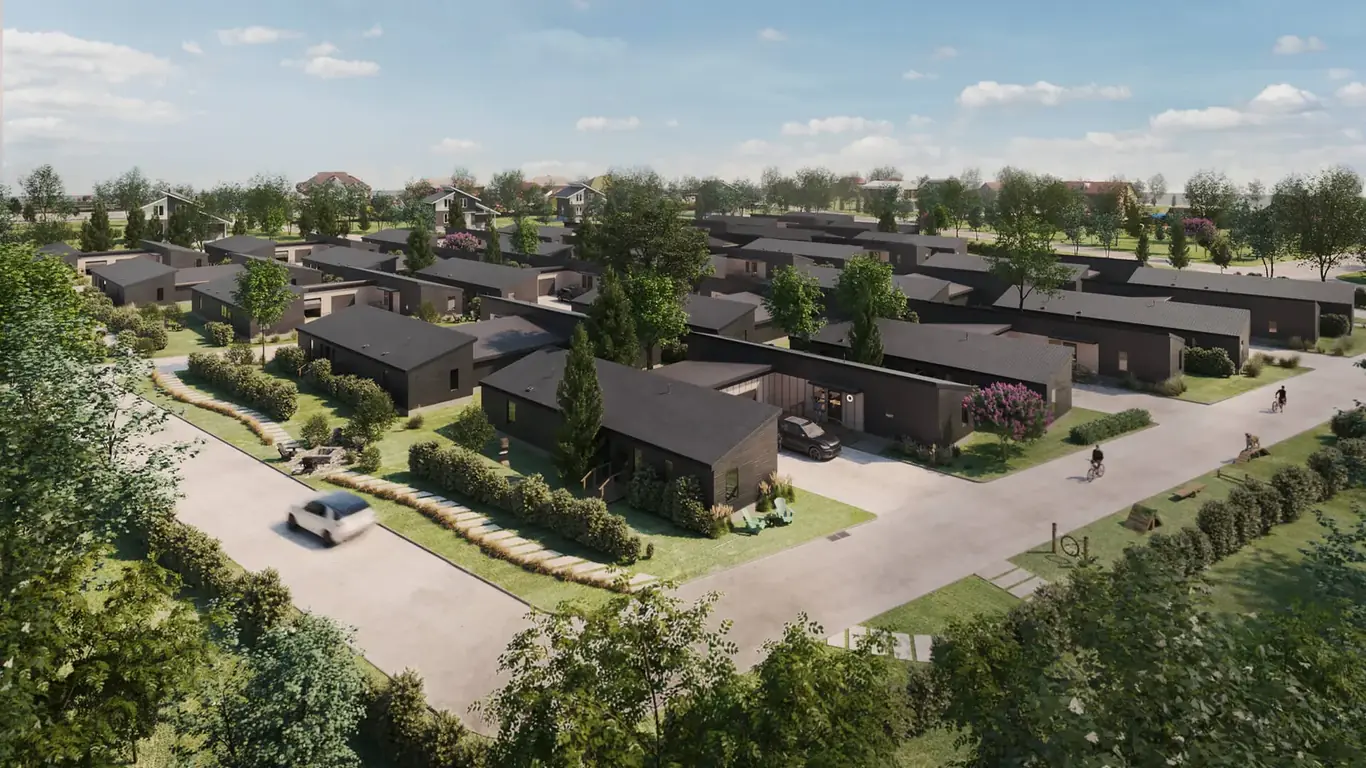
Aerial renders answer the question that no street-level view can: what does this development look like in relation to the city? For master-planned communities, mixed-use projects, and large residential sites, the aerial render is the primary investor and planning asset. It shows the full site — building footprints, landscaping, road access, amenity zones, surrounding development context — in a single image that tells the complete story.
3D floor plans → "Does this layout work for my life?"
3D floor plans solve the problem buyers struggle with most when reading 2D drawings: spatial comprehension. A furnished 3D floor plan shows room sizes at actual furniture scale, confirms circulation routes, and makes spatial relationships legible to buyers who aren't trained to read technical drawings. For off-plan sales with multiple unit types, 3D floor plans function as self-qualification tools — buyers understand which layout fits their lifestyle without a sales consultant walking them through every dimension.
Walkthroughs → "Can remote buyers commit without visiting?"
A 60-to-90-second animated walkthrough moves through the development — street arrival, lobby, amenity deck, representative unit — and gives international buyers and out-of-state investors a spatial experience that dramatically reduces "I need to see it in person" deferrals. For projects targeting overseas buyers, the walkthrough is often the single asset that converts remote interest into a reservation.
Virtual staging → "Can I see this as a home, not a vacant unit?"
For completed units that are vacant, virtual staging adds photorealistic furniture to photography of the empty space without the cost of physical staging. Virtually staged homes consistently achieve 98–99% of asking price versus 96–97% for unstaged properties. At any meaningful price point, the 2–3% price improvement significantly exceeds the virtual staging cost. The global virtual staging market reached $1.33 billion in 2026 as adoption spread from luxury listings into standard practice.
Which renders belong on which marketing channel
Every competitor article tells you which render types exist. None of them explain how the same render needs to be deployed differently across channels — and how channel requirements should shape what you commission. Here's how the six render types map to the real estate marketing ecosystem:

| Channel | Primary renders needed | Format considerations |
|---|---|---|
| Project website | Hero exterior, interior gallery, 3D floor plans, walkthrough embed | Full-res JPEG for gallery; MP4 for embedded walkthrough; PNG floor plans |
| Zillow / Realtor.com | Exterior render as hero image, interior renders in photo gallery | Hero image renders best at landscape 4:3 or 16:9; minimum 1024px wide |
| Instagram / social | Exterior renders (dusk variation), interior lifestyle shots | Square crop (1:1) for feed; 9:16 vertical crop for Reels and Stories |
| Broker deck / investor packet | Aerial render, hero exterior, 2–3 interiors, floor plan matrix | High-res PDF export at 300 DPI; full bleed at print dimensions |
| Construction site hoarding | Hero exterior render only | Supplied as vector or 150+ DPI at final print size; often 5–15m wide |
| Sales brochure / print | Full render package with bleed | 300 DPI minimum; CMYK color profile; bleed margins per printer spec |
| Google Display / paid ads | Hero exterior crop, interior lifestyle crop | Multiple standard sizes: 300×250, 728×90, 160×600, 1200×628 |
The practical implication: when briefing a studio, specify every channel the renders will appear on. A render produced for a project website at 2560px wide can be cropped for Instagram and scaled down for ads. But if the composition wasn't planned with the square crop in mind, the key visual element (the building entrance, the skyline view) may fall outside the Instagram frame. Planning channel deployment at the brief stage costs nothing. Retrofitting after delivery costs revision fees and time.
When to commission each render type
The most common visualization timing mistake is commissioning renders too late — waiting until the design is fully resolved before briefing a studio. By the time the renders are ready, the window for investor presentations and pre-launch marketing is already closing. Here's the strategic sequence:
- End of schematic design — commission exterior renders and the aerial render for investor presentations and planning submissions. The design doesn't need to be construction-document ready; a good studio can update renders as the design evolves at revision cost rather than full project cost. Having renders at this stage means you enter investor meetings with visual evidence, not conceptual sketches.
- Pre-launch (6–12 months before sales open) — release the hero exterior render publicly to generate registration interest. A strong launch image builds a waiting list that gives your sales team first-week leverage. This is also when construction hoarding should go up — the render on the hoarding is marketing to thousands of people driving past the site daily.
- 2 months before sales launch — commission and complete interior renders, 3D floor plans, and the walkthrough video. These need to be ready before the sales gallery opens, not after. Buyers who register early and visit on day one of sales should see the complete visualization package — not a partial set.
- Sales launch — full visualization package goes live simultaneously across all channels: project website, listing platforms, social, and sales gallery.
- Construction phase — update renders if design changes occur. Maintaining consistency between the visualizations buyers committed to and the finished product is both a credibility issue and, in some jurisdictions, a legal one.
Matching the package to your project type
The right visualization package depends on what you're selling and who you're selling it to. Over-investing in render types that don't support buyer decisions wastes budget. Under-investing on the assets that do misses sales. Here's how the package scales by development category:
| Project type | Essential renders | Add if budget allows |
|---|---|---|
| Luxury residential (high-rise / single-family) | Hero exterior (premium quality), dusk variation, 2–3 interiors of key spaces, 3D floor plans | Full unit walkthrough, aerial render, photomontage in context |
| Market-rate for-sale residential | Hero exterior, 2 interiors of primary living spaces, 3D floor plans per unit type | Aerial render, dusk variation of exterior |
| Master-planned community | Aerial master plan render, representative interior renders, lifestyle amenity renders | Animated community walkthrough, phase sequence renders |
| Commercial / mixed-use | Exterior render (architectural / context-focused), aerial render, floor plate render | Interior renders of anchor tenant spaces, animated lobby walkthrough |
| Completed vacant units | Virtual staging of key spaces (living room, kitchen, master suite) | Dusk exterior if original render is dated |
For luxury projects, the rule is: spend where the buyer spends time looking. Buyers of $3M+ units study interior renders for minutes. A lower-resolution interior render at the luxury price point undermines the price justification immediately — material accuracy matters at that level. For market-rate projects, the priority is clarity over spectacle: buyers need to understand the layout and livability without ambiguity, not be wowed by cinematic lighting.
What makes a render convert, not just impress
There's an important distinction between renders that impress and renders that convert. Impressive renders demonstrate technical skill. Converting renders answer the specific question that buyer is facing when they look at that image.
The most common reason visualization underperforms is a mismatch between what the render shows and what the buyer needs to decide. A spectacular aerial render doesn't help a buyer choose between a two-bedroom and three-bedroom floor plan. A cinematic walkthrough doesn't help a planning board evaluate massing compliance. Before briefing a studio, identify the specific decision each visualization needs to support — and optimize the composition, viewpoint, and staging for that decision.
Four elements that consistently drive conversion in buyer-facing renders:
- Furniture at realistic scale. Buyers self-qualify on whether their life fits the floor plan. A living room rendered with a properly scaled sofa and coffee table tells them whether the apartment works for how they actually live. Empty rooms or undersized placeholder furniture undermine that self-qualification entirely.
- Material accuracy matching the price point. A luxury unit render with generic surface materials sends a subconscious message that the quality won't match the price. Buyers compare renders to price. Premium finishes in the renders — correct stone veining, accurate hardware, real fabric textures — justify the price point visually before the buyer reads any specifications.
- Lifestyle entourage in exterior renders. People, street activity, and activated ground-floor retail in exterior renders sell the neighborhood as much as the building. A render showing an empty sidewalk in front of an otherwise excellent building misses the aspiration buyers are actually buying: the life they'll have there, not just the structure.
- Lighting that creates desire. Golden hour exterior renders and warm-lit interior renders trigger aspiration. Flat-lit renders at neutral times of day communicate information but don't create emotional pull. For renders aimed at driving registrations or inquiries, lighting is a conversion variable, not just an aesthetic choice.
Measuring the ROI
For most development projects, visualization ROI is measurable in three categories. Pre-sales velocity: developments with thorough visualization packages consistently achieve 40–50% pre-sales before groundbreaking versus 15–20% without. That gap directly determines construction financing terms and the developer's negotiating position with lenders. Price achieved: properties marketed with professional 3D visualization sell at 8–9% price premiums on average over comparable projects marketed with drawings only — at any meaningful project scale, the revenue gain exceeds the total visualization cost many times over. Marketing efficiency: digital campaigns with 3D visualization assets generate higher click-through rates, longer on-site engagement, and lower cost-per-lead than campaigns using floor plans and photographs of empty sites.
The visualization investment for a typical mid-size residential development is 0.04–0.10% of total project revenue. The pre-sales velocity improvement and price premium it supports represent returns measured in percentage points. Of all the marketing expenditures in a development budget, professional visualization consistently has among the clearest ROI cases. For a deeper look at how rendering for real estate marketing campaigns is structured from strategy through channel deployment, see our dedicated guide. For practices working primarily on listings and buyer-facing visualization, our article on 3D rendering for real estate agents covers the agent-specific workflow in detail. For a breakdown of what different visualization packages cost at various project scales, see our rendering pricing page.
To evaluate quality before committing to a studio, browse our portfolio of completed real estate visualization work. For an honest comparison of studio options, see our guide on how to choose a 3D rendering studio. We provide free project estimates within 2 hours for all development scales — contact us to discuss your project's visualization requirements.
Ready to build your visualization campaign?
Tell us about your development and we'll recommend the right package — with a free estimate within 2 hours.
Request a Free Estimate