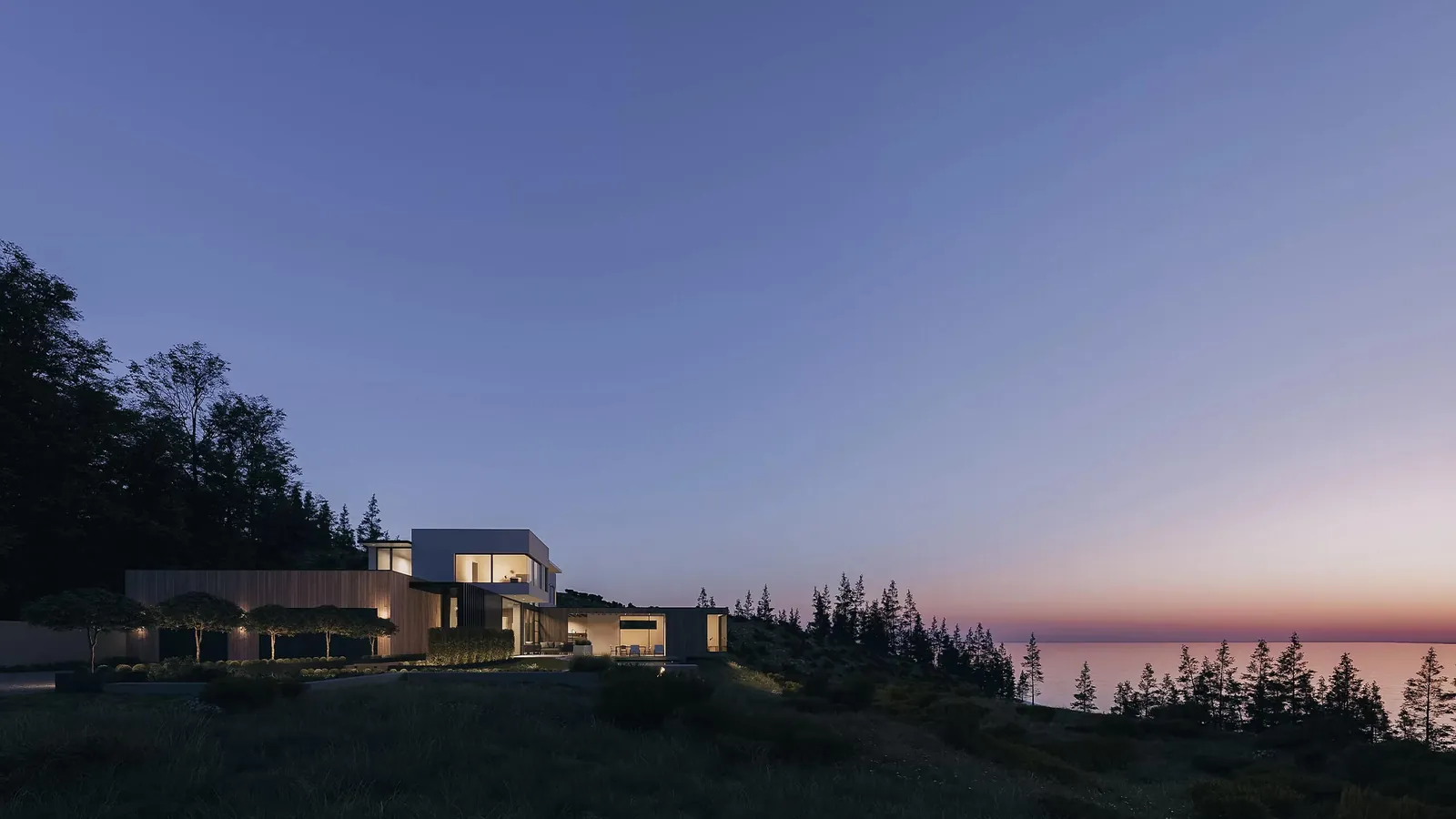
Real estate agents face a consistent challenge: buyers make decisions based on emotion, but they often need to visualize a property that either doesn't exist yet, is empty and hard to imagine furnished, or looks nothing like its potential because of dated finishes or poor staging. Photography shows what's there. 3D rendering shows what will be — or what could be.
In the Los Angeles market, where pre-construction condo sales, custom home spec builds, and high-end vacant properties make up a significant share of listings, agents who use professional 3D visualization consistently report faster sales cycles and stronger buyer engagement than those relying on photography alone. The investment is modest compared to listing revenue; the differentiation is significant in a market where every listing competes for attention online.
This guide covers the specific ways real estate agents use 3D rendering, what each application costs, and how to brief visualization that serves your listing goals.
Pre-Construction and New Development Sales
The highest-value application of 3D rendering for real estate agents is pre-construction sales — selling units, lots, or homes that don't yet exist. In California, pre-construction condo sales, new single-family developments, and spec homes all require buyers to commit to a purchase based on drawings and descriptions rather than a physical space. Photorealistic renders bridge this gap by giving buyers a visual reality to respond to.
For condo pre-sales, the standard visualization package includes exterior renders of the building, interior renders of each unit type (one-bed, two-bed, penthouse), and 3D floor plans showing unit layouts. This content goes on the development website, into printed brochures, and onto the sales office walls. Buyers who visit the sales office after seeing the renders online arrive with a clearer mental picture of what they're buying, fewer fundamental questions, and a higher propensity to commit.
For new spec homes or custom homes being marketed before completion, exterior renders showing the completed elevation plus interior renders of key spaces (living room, kitchen, master suite) are typically sufficient to establish the product's quality and character. These renders go directly into MLS listings, which consistently generate more leads and shorter time-on-market than equivalent listings with only plan images or construction-site photography.
Virtual Staging for Vacant Properties
Vacant residential properties photograph poorly. Empty rooms look smaller than furnished ones, lack the warmth and livability that buyers are looking for, and fail to help buyers imagine how their life would fit in the space. Physical staging — renting furniture and accessories and installing them for the listing period — costs $1,500–$5,000 for a standard home and requires ongoing maintenance and a move-out at the end of the listing period.
Virtual staging renders the property's actual rooms with digitally placed furniture, rugs, artwork, lighting, and accessories — producing photographs that look identical to a professionally staged space but require no physical setup, no ongoing cost, and no move-out. Virtual staging renders typically cost $200–$400 per room and are delivered in 2–4 business days. For a 4-bedroom listing where the living room, kitchen/dining, master bedroom, and one secondary bedroom are virtually staged, the total cost is $800–$1,600 — compared to $2,000–$5,000 for equivalent physical staging.
The most effective virtual staging focuses on the rooms that matter most to buyers: the living room, kitchen, and master bedroom are the three spaces that drive listing engagement. Secondary bedrooms, bathrooms, and utility spaces have less impact on buyer interest and can typically be shown as clean empty rooms without staging.
Renovation Potential Visualization
Many residential listings involve properties with significant renovation potential — dated kitchens, bathrooms that need updating, or layouts that buyers know intellectually could be opened up but can't easily visualize. Renovation potential renders show the property as it could look after a specified renovation — new kitchen, new bathrooms, opened floor plan — using the actual dimensions and structure of the existing property.
This application is most effective for properties where the asking price reflects renovation potential that buyers aren't fully crediting. A render showing a $50,000 kitchen renovation result — taking the property from dated to desirable — helps buyers understand and justify the premium they're paying for a property that hasn't been renovated yet. It also positions the agent as a service provider who has done the visualization work for the buyer rather than leaving them to imagine the potential on their own.
Renovation potential renders require the existing floor plan (or an as-built measurement by the agent) and a defined renovation scope. The scope doesn't need to be contractor-specified — a general design direction is sufficient for the render to communicate the concept. Cost is typically $500–$900 for a primary room view.
Aerial Context for Land and Larger Properties
For land listings, waterfront properties, equestrian estates, and large residential properties where the site context is a primary selling point, aerial renders provide a bird's-eye view of the site that property photography can rarely capture effectively. Drone photography shows the site as it currently exists; aerial rendering can show a proposed building on an empty lot, or place the property accurately in its landscape context.
For vacant land listings, an aerial render showing a conceptual building on the site — not as a binding commitment but as a visualization of what's possible — is an effective tools for communicating land value to buyers who struggle to translate a lot size into a mental image. This is particularly effective in hillside, canyon, and coastal markets where site topography is both a feature and a planning constraint.
3D Floor Plans for MLS and Marketing
3D floor plans — rendered from a slightly elevated oblique camera showing the plan with furniture, room proportions, and flow — have become a standard listing feature in higher-end markets. Buyers who review a 3D floor plan on Zillow or Realtor.com develop a significantly stronger spatial understanding of the property than buyers who review a standard 2D plan, which most non-architects find difficult to interpret.
For listings in the $700K+ range in Los Angeles, 3D floor plans are now expected rather than differentiating. Below that price point, they remain a competitive advantage. 3D floor plans cost $300–$500 per floor and take 3–4 business days to produce from the existing floor plan. See our 3D floor plan service for details.
Pricing Summary for Agents
| Service | Typical Use | Price Range | Timeline |
|---|---|---|---|
| Virtual staging (per room) | Vacant residential listing | $200–$400 | 2–4 days |
| 3D floor plan (per floor) | All residential listings | $300–$500 | 3–4 days |
| Renovation potential render | Fixer-upper listings | $500–$900 | 4–6 days |
| Exterior render (new construction) | Pre-construction / spec homes | $600–$1,200 | 4–6 days |
| Aerial context render | Land, large sites, coastal | $800–$1,500 | 5–8 days |
For pre-construction condo and new home development listings, developers typically commission the visualization package and provide renders to agents marketing the project. For individual agent listings — vacant homes, renovation-potential properties, land — the agent typically commissions visualization as part of their marketing investment. See our full pricing page for current rates.
For a broader overview of how real estate professionals use 3D visualization, see our articles on 3D rendering for real estate marketing and virtual staging vs. 3D rendering.
Listing a Property That Needs Visualization?
Tell us the listing address and your marketing needs — we'll recommend the right package and deliver a scoped estimate within 2 hours.
Get a Listing Quote