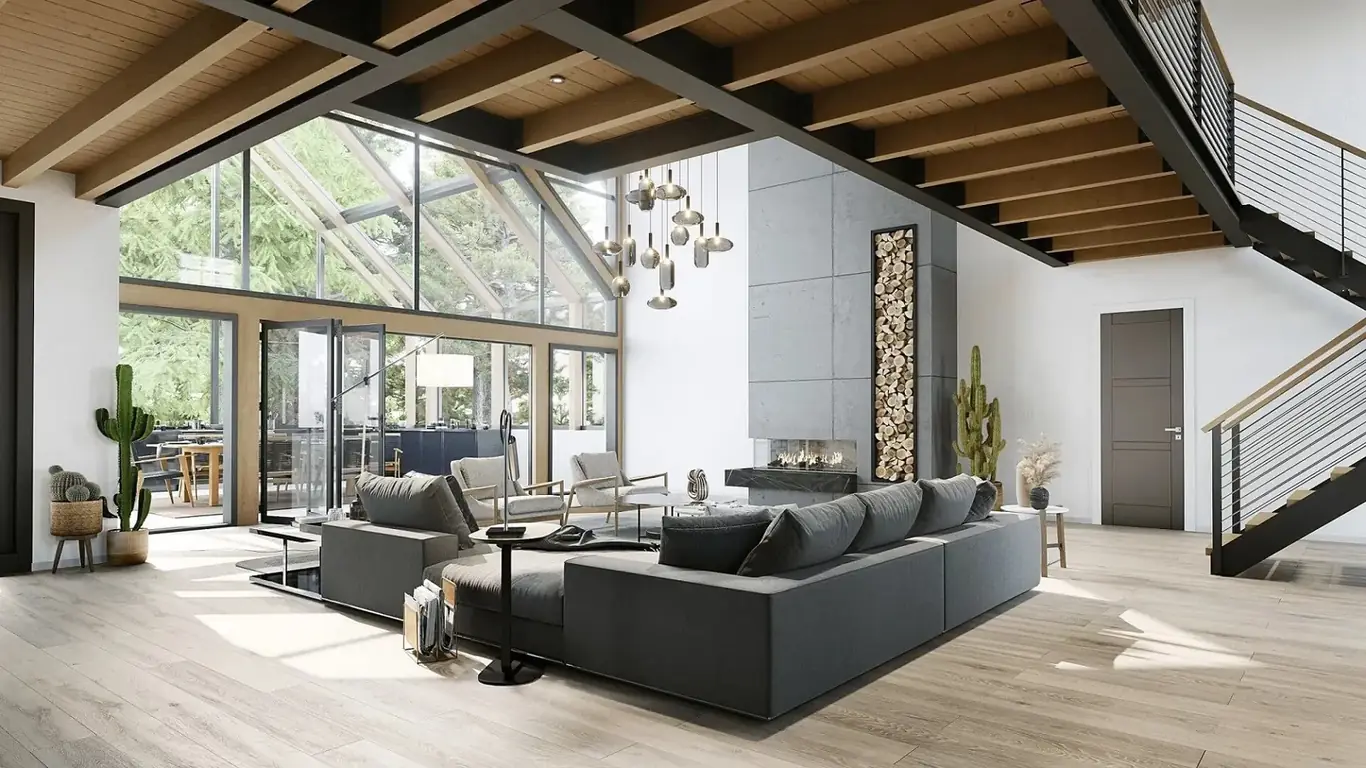
The conversation about virtual staging versus 3D rendering often gets framed as a choice between fast-and-cheap versus slow-and-expensive. That framing is wrong, and it leads to bad decisions. The real distinction is simpler: virtual staging requires a physical space that already exists; 3D rendering produces visuals of a space that doesn't exist yet. Once you understand that, the choice becomes obvious in most situations.
What Virtual Staging Actually Is
Virtual staging is the process of taking a photograph of a real, empty room and digitally adding furniture, finishes, and decor to make it look occupied and appealing. The room exists. You've photographed it. The staging is composited into the photo in post-production.
Modern AI-powered virtual staging tools can produce results in under 60 seconds at $1–$10 per image. Traditional virtual staging services using manual 3D artists take 24–48 hours and charge $50–$150 per image. Both approaches have the same fundamental constraint: they require a real space that can be photographed.
Virtual staging is primarily a tool for real estate agents and sellers marketing completed, vacant properties for resale. A vacant condo that would otherwise list with cold, empty photos becomes a warm, furnished space with virtual staging applied to the listing photographs. For agents using visualization more broadly across their listing business — from pre-construction to completed properties — our guide on 3D rendering for real estate agents covers the full workflow from listing presentation through MLS deployment.
What 3D Rendering Actually Is
3D rendering creates a photorealistic image of a space entirely from architectural drawings and design specifications — before the space exists at all. There is no physical room, no photography. A 3D artist builds a digital model of the space, applies materials and lighting, and renders it as a camera-quality image.
3D rendering is the primary visualization tool for:
- Pre-construction projects — apartments, houses, commercial spaces that aren't built yet
- Design approval — showing clients what a space will look like before construction begins
- Pre-sales and pre-leasing — marketing units that don't exist
- Renovation planning — showing what a remodeled space will look like before demolition begins
- Design development — testing materials, furniture arrangements, and lighting concepts
The Core Distinction
| Criterion | Virtual Staging | 3D Rendering |
|---|---|---|
| Space requirement | Must already physically exist | Works from drawings — space need not exist |
| Starting point | Photographs of the real space | Architectural drawings and specifications |
| Speed | Minutes to hours | 3–10 business days |
| Cost | $1–$150 per image | $299–$1,200+ per image |
| Use for pre-construction? | No — space must exist first | Yes — this is the primary use case |
| Design changes | Furniture only — can't change architecture | Any element can be changed in the model |
| Luxury segment quality | Often reads as staged to sophisticated buyers | Indistinguishable from photography when done well |
| Multi-view consistency | Limited to photographed angles | Any view from the same model |
When Virtual Staging Makes Sense
Virtual staging is the right choice when you have a completed, vacant property that you need to market quickly for resale or leasing. An empty two-bedroom that photographed well structurally but feels cold and uninviting in the listing photos is a classic virtual staging use case. The goal is to help buyers emotionally connect with the space — not to visualize something that doesn't exist yet.
For high-volume real estate agents listing multiple vacant properties per month, virtual staging at $5–$50 per room is an efficient cost. The alternative — physical staging with rented furniture — costs $1,500–$5,000 per property per month, which is rarely justified for a mid-range residential listing.
Virtual staging also works for hospitality listings: short-term rental operators can stage vacant spaces on platforms like Airbnb or VRBO before physically furnishing them, using the staged images to assess market response before committing to furnishing costs.
When 3D Rendering Is the Only Option
If the space doesn't exist yet — whether it's unbuilt, under renovation, or only in design — virtual staging simply can't help. You need 3D rendering. There is no workaround.
For real estate developers selling off-plan (units in pre-construction), interior renders are the primary tool for the pre-sales campaign. The developer may sell 40–60% of a project before breaking ground, using renders as the sole visual representation of what buyers are committing to. Virtual staging of a comparable unit in a similar building is sometimes used as a supplement, but it is not a substitute for renders of the actual project.
The Quality Ceiling of Virtual Staging
There is a quality ceiling with virtual staging that becomes relevant in the luxury segment. Sophisticated buyers — particularly at price points above $1.5M — often perceive something subtly off in virtually staged images, even when they can't articulate it. The lighting mismatch between the real photographed space and the digitally composited furniture, the shadows that don't quite align, the furniture proportions that are slightly idealized — these cues register subconsciously.
High-end 3D rendering, produced by skilled artists from actual design specifications, does not have this problem. When produced to a high brief, a full 3D render is genuinely indistinguishable from architectural photography. For luxury residential projects where the marketing material must position the property at the very top of the market, 3D rendering outperforms virtual staging on perceptual quality.
The Practical Decision Framework
Use this to decide:
- Is the space built and vacant? → Virtual staging for resale/leasing marketing is appropriate and cost-effective
- Is the space unbuilt or under design? → 3D rendering is the only option
- Is it a luxury property above $1.5M? → Consider 3D rendering even for a completed space, especially for key marketing images
- Do you need to show the space from angles that weren't photographed? → 3D rendering (virtual staging can only use the photographed angles)
- Do you need to change finishes or layout, not just furniture? → 3D rendering (virtual staging can't modify architectural elements)
Our interior rendering services produce finished spaces from your drawings at any stage of design or construction. For a broader comparison of visualization approaches, see our article on 3D rendering vs. AI-generated images. For how renders work alongside real photography, see CGI vs. architectural photography.
Need to Visualize a Space Before It's Built?
Send us your drawings and we'll have a scoped estimate within 2 hours.
Request a Free Estimate