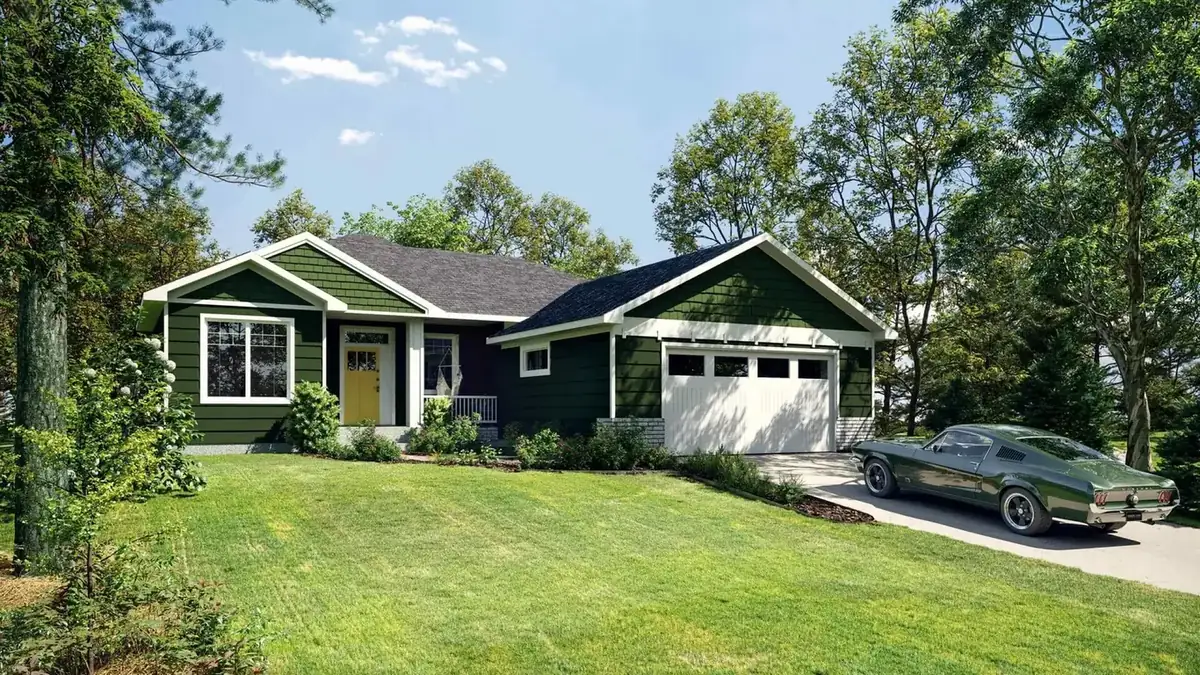
"Should we hire a US studio or send this offshore?" is one of the most common questions architects and developers ask when commissioning renders, and it's usually framed as a simple cost trade-off. The real picture is more nuanced. Offshore freelancers and studios genuinely undercut US pricing, but the same rendering software is sold worldwide, award-winning work comes from every region, and the biggest risks (botched revisions, unclear IP, leaked pre-release designs) track to contracts and process rather than to a country.
This guide compares domestic (US), offshore, and hybrid rendering studios across the four things buyers actually weigh (cost, quality, IP and security, and turnaround), using 2026 data, with every figure linked to its source. Where the public data genuinely doesn't exist, we say so rather than guess. The short version: there's no universal winner, the software is not the differentiator, and a clear contract protects you more than a studio's passport.
Domestic vs offshore vs hybrid: the quick comparison
Here's the decision at a glance. The sections that follow back each row with sourced data.
| Factor | Domestic (US) | Offshore | Hybrid |
|---|---|---|---|
| Cost | Highest. US labor benchmark ~$49/hr | Lowest sticker, widest spread. Freelancer rates often ~$12–35/hr | Mid-range: offshore production, US-side management markup |
| Quality | Strong when art direction and live iteration matter | Commodity to award-winning; depends on the studio, not the country | Often the best compromise if US-side art direction leads |
| IP & security | Simplest legal path; same-jurisdiction enforcement | Higher cross-border friction; manageable by contract | Strong if the US entity contracts and controls vendors |
| Turnaround | Easy same-day collaboration; ~5–10 business days a still | Overnight progress possible; feedback loops can lag | Continuous throughput: US-day feedback, offshore-night work |
| Best fit | Sensitive, iterative, high-stakes work | Budget-clear scope, production overflow | Ongoing pipelines needing control and scale |
Market context: a fast-growing field with one missing number
Buyers are choosing inside a fast-growing market. Grand View Research values the global 3D rendering market at $4.85 billion in 2025, projecting it to reach $19.82 billion by 2033 at a 19.6% CAGR, with North America accounting for 35.2% of the 2025 total (Grand View Research, 2026). The same firm puts the US market at roughly $1.3 billion in 2025 (Grand View Research US outlook).
What no reliable public source provides is the one number this debate seems to need: the share of architectural rendering that is actually outsourced or offshored. It simply isn't measured cleanly. The closest signal comes from the Chaos and Architizer industry survey, which found that more than 75% of architecture firms produce visualizations in-house and only 8.8% use a mix of in-house and outsourced services (Chaos / Architizer, 2025). That measures internal workflow, not offshore procurement — so treat any confident "X% of renders are offshored" claim as unsupported.
Where offshore production clusters is better established: India, Eastern Europe (Ukraine, Poland, Serbia), Southeast Asia (Vietnam, the Philippines), and Latin America (Brazil, Colombia, Argentina). The driver is labor economics plus mature tool adoption, not privileged access to software — a point the cost and quality sections make concrete.
Cost: what the data actually shows
The cost gap is real but messier than a single multiplier. Start with labor. The closest US public benchmark is the Bureau of Labor Statistics figure for special-effects artists and animators: a $99,800 median annual wage as of May 2024 (BLS Occupational Outlook Handbook), or about $49.06 per hour (O*NET / BLS). It's not a perfect "archviz artist" code, but it's the strongest public anchor for US rates.
Offshore labor sits well below that. Live Upwork country pages surface architectural-rendering freelancer rates around $15–23/hr in India, $25–35/hr in Ukraine, $12–25/hr in the Philippines, $20–48/hr in Serbia, and $18–25/hr in Colombia (Upwork country hiring pages). Those are individual profile rates, not studio-wide averages, and they overlap at the top end — but the direction is clear.
By project, Upwork's own hiring guide puts architectural-rendering specialists at $25–40/hr, with typical bands of $200–500 for an interior still, $400–1,000 for an exterior facade, $800–2,500 for a photorealistic visualization, and $3,000–10,000 for a walkthrough (Upwork, 2026). Staffed studios, domestic and offshore alike, generally price above freelancers; published studio guides commonly show offshore stills landing materially below US boutique-studio pricing, though those are vendor quotes, not audited market averages.
The cheapest quote is rarely the final cost. The Chaos and Architizer survey found that 85% of professionals occasionally or regularly receive client requests to change visualizations (Chaos / Architizer, 2024–2025), so revision handling, brief interpretation, and out-of-scope policy shape the true price as much as the headline rate. No public dataset measures management overhead or rework by sourcing model, so budget for those as real but unmeasured. For how we scope and quote transparently, see our pricing page and our breakdown of how much 3D rendering costs.
Quality is about process, not geography
The idea that domestic studios produce better work because they have better tools doesn't hold up. The same core stack is sold and supported worldwide: Chaos licenses V-Ray and Corona globally, Autodesk sells 3ds Max everywhere, and Epic's Unreal Engine and D5 Render are available on the same terms internationally. Offshore freelancer profiles across India, Ukraine, Serbia, and the Philippines list that identical toolset in live client work. Software is standardized; quality variance comes from elsewhere.
What it comes from is art direction, process maturity, revision management, and brief quality. The Chaos and Architizer survey shows photorealistic work is the center of demand: 63% of firms create photorealistic visualizations frequently, yet 43% say high-quality visuals take too long to render (Chaos / Architizer, 2024–2025). Geography solves none of that; individual studios do.
Excellence is also demonstrably global. The 2025 CGarchitect 3D Awards, one of archviz's clearest cross-border quality benchmarks, recognized studios and artists from Belgium, Ukraine, Serbia, Hungary, and the United Kingdom (CGarchitect 3D Awards 2025). Because there's no public dataset breaking out first-draft acceptance or revision rates by sourcing model, the objective way to judge quality is portfolio consistency, proof of commissioned authorship, and recognition like this — not the studio's location. Our guide on how to choose a 3D rendering studio covers how to vet that.
IP, contracts, and data security
This is where location has real, practical weight — though contract language carries more. Under US law, the author owns the copyright by default unless the work is a valid "work made for hire" or the rights are transferred in writing. The Copyright Office explains that a work is made for hire only when created by an employee within their job, or when it's specially commissioned within one of nine statutory categories and both parties sign a written agreement (US Copyright Office, Circular 30).
That list does not expressly include architectural renderings, so a commissioned render should not be assumed to become the client's property automatically — the safe practice is a written copyright assignment.
Transfers can also be recorded with the Copyright Office, which provides constructive notice and helps establish priority between conflicting transfers (US Copyright Office, Circular 12). That helps domestic chain-of-title but doesn't erase cross-border enforcement friction, which is the offshore risk that's practical rather than theoretical. International bodies exist precisely for this: WIPO offers mediation and arbitration for cross-border IP disputes, and the New York Convention makes foreign arbitral awards generally enforceable across signatory countries (UNCITRAL). The takeaway: a contract that names governing law, venue, and an arbitration procedure protects you far more than a generic NDA.
Data protection can actually favor a well-run EU-based studio. Transfers of personal data out of the EU generally require safeguards such as Standard Contractual Clauses (European Commission), and GDPR Article 28 bars processors from bringing in subprocessors without prior written authorization (GDPR Art. 28) — useful when project files contain resident names or unit schedules.
In the US, California's privacy regulations remain in force in 2026 (California Privacy Protection Agency) within a state-by-state patchwork. Since there's no public incidence data on rendering-related design leaks by geography, protect yourself contractually: ban undisclosed subcontracting, name storage locations, require return-or-delete of source files, and specify whether you receive only finals or also the native scene files.
Turnaround and time zones
Speed is a genuine trade-off, not a one-way offshore advantage. Public timeline guidance clusters around a few days for a single still regardless of geography: Upwork's guide cites 3–7 business days for a quality exterior still and 2–4 weeks for an animated walkthrough (Upwork, 2026), and most US studios quote roughly 5–10 business days for a polished still once briefing and revisions are counted.
Offshore teams can turn time-zone separation into overnight progress — but only with disciplined management, because live collaboration gets harder as the clock gap widens. In July 2026, New York is roughly 7 hours behind Kyiv, 9.5 hours behind New Delhi, and 11 hours behind Ho Chi Minh City, while it sits only about 1 hour behind São Paulo and 1 hour ahead of Bogotá (timeanddate.com).
That maps cleanly to workflow. Eastern Europe gives East Coast teams a partial same-day overlap; India and Southeast Asia are built for overnight, asynchronous production; Latin America offers nearly a full shared business day for live review sessions. Which is "fastest" depends on whether your project needs synchronous, workshop-style feedback or asynchronous overnight throughput — a scoping question as much as a sourcing one, and one worth settling alongside how many renders your project needs.
The hybrid model: US handling with global production
The hybrid model deserves to be treated as its own category, not a disguised offshore option. Structurally it pairs US-facing account management, art direction, or project leadership with distributed or offshore production. Reliable prevalence data doesn't exist, but the structure is visible in real companies: N2Q Studio, for instance, runs its production out of Vietnam while registering and fronting the business in the US (N2Q Studio).
The appeal is intuitive and consistent with the evidence above: lower cost than all-domestic production, clearer communication and contract confidence than pure offshore, and better overnight throughput than an all-US team.
The weaknesses are just as real — you may pay a management markup, the operational chain is longer, and undisclosed-subcontracting risk rises unless the contract names the actual production entity and data path. This is the model where chain-of-custody language matters most, because the value depends on the US-side lead genuinely holding art direction and review authority rather than merely relaying files.
How to choose: a location-agnostic checklist
The evidence doesn't crown one model. It rewards matching the studio to the job and, above all, getting the contract right. Domestic teams fit sensitive, heavily iterated, or legally exposed work with live stakeholder sessions. Offshore teams fit visually clear, budget-sensitive scopes and production overflow. Hybrid teams fit ongoing pipelines that need both communication control and scalable capacity. Beyond that fit, the same controls protect you regardless of where the studio sits:
- Ownership in writing. Specify who owns the finals, the native source files, and any reusable assets — and include an explicit copyright assignment if rights must vest in you.
- Confidentiality with teeth. An NDA plus a clause banning undisclosed subcontracting, especially for unbuilt or pre-launch projects.
- Governing law and dispute path. Name the venue, governing law, and an arbitration or mediation procedure — the enforceable backbone behind any cross-border deal.
- Scope and revisions. Define review rounds, what counts as out-of-scope, the turnaround SLA, and the rush policy in advance.
- Proof of quality. Verify portfolio authorship, ask for commissioned examples, and weigh recognition like award wins over marketing claims.
- A review rhythm that fits the clock. Match your feedback cadence to the studio's time zone instead of fighting it.
Get those right and the studio's location becomes a preference rather than a risk. For a domestic-timezone team with the account handling and IP terms above, that conversation starts with a brief and an estimate.
Want US-based handling with studio-grade production?
Send us your project and requirements — we'll scope it with clear IP terms, revision rounds, and turnaround, and send a free estimate within 2 hours.
Request a Free Estimate