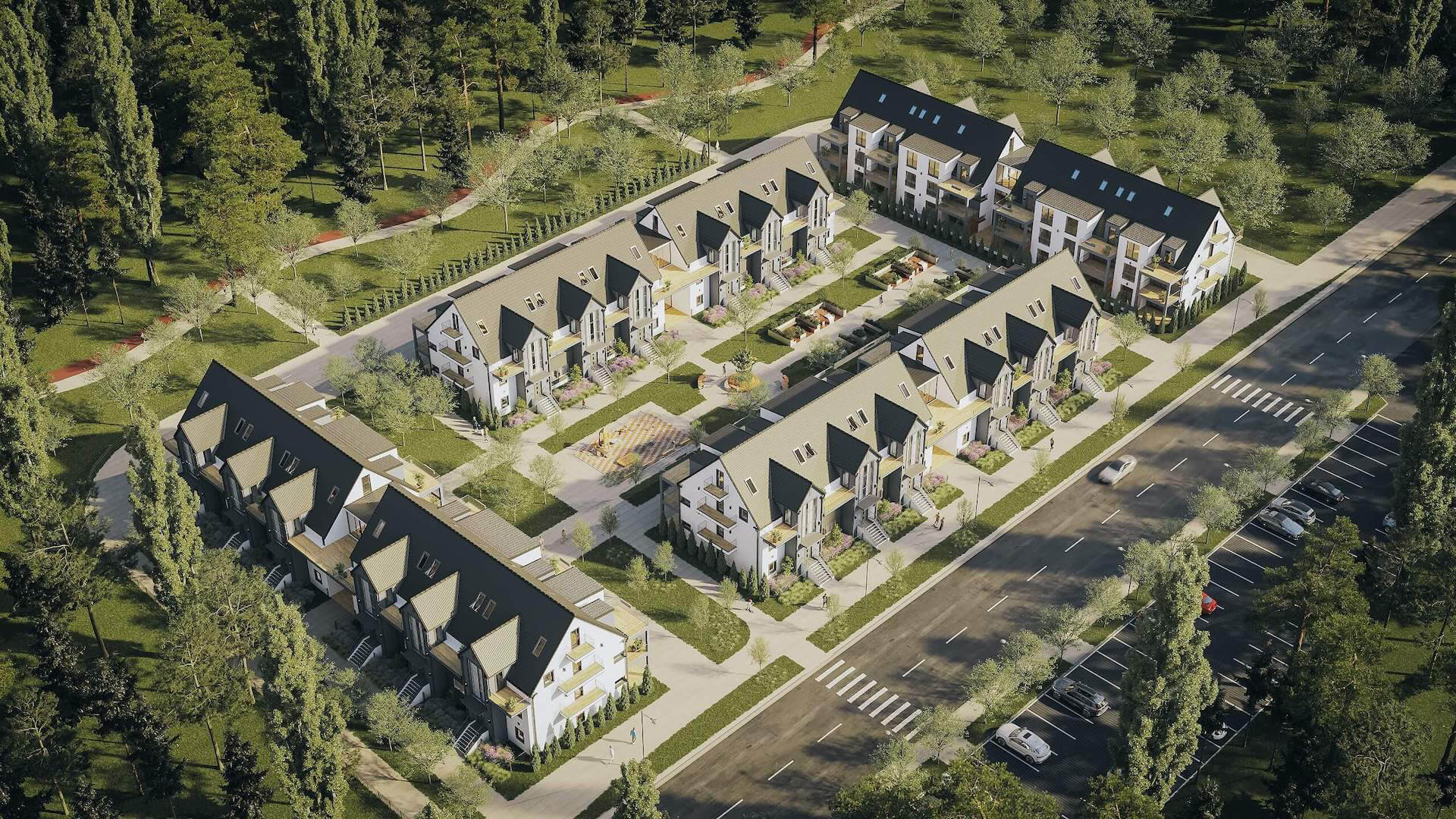
Los Angeles is in the middle of a housing production cycle unlike anything it has seen in decades — shaped simultaneously by a declining permit trend, a persistent ADU boom, sweeping new state legislation, and a resale market that has softened significantly from its 2022 peak. For developers, architects, and visualization professionals working in this environment, the question isn't whether to use 3D rendering in pre-sales marketing. It's how early, how extensively, and to which audiences.
This analysis draws on primary data from the U.S. Census Bureau, LA City Planning's Housing Element Annual Progress Reports, Zillow, the National Association of REALTORS®, Chaos/Architizer's 2025 State of Archviz survey, and current market data from Realtor.com. All statistics are cited by source. Where data wasn't available in publicly verifiable form, I've said so rather than estimating.
The LA Development Pipeline: Permits Are Declining
The headline number for Los Angeles County's development pipeline tells a clear story of contraction. According to the U.S. Census Bureau Building Permits Survey, published via the Federal Reserve Bank of St. Louis, authorized housing structures in LA County have fallen significantly over three years:
| Year | Authorized Housing Structures | Year-over-Year Change |
|---|---|---|
| 2022 | 26,572 | — |
| 2023 | 24,286 | −8.6% |
| 2024 | 19,809 | −18.4% |
Source: FRED / U.S. Census Bureau Building Permits Survey (BPPRIV006037).
The 25.5% decline from 2022 to 2024 reflects a combination of higher construction costs, elevated interest rates through most of this period, and the general cooling of the capital markets environment for new development. Notably, these are permits-based counts; they don't directly enumerate mixed-use projects or track which permitted units actually begin construction.
Within the City of Los Angeles specifically, the 2024 Housing Element Annual Progress Report records 17,195 total permitted units for Reporting Year 2024 — a more granular count that covers the city rather than the full county.
The ADU Exception: A Stable Production Channel
While overall permit activity has contracted, accessory dwelling unit production in the City of Los Angeles has remained remarkably consistent. The City's Housing Element APR data shows permitted ADU units holding near 7,000 annually despite the broader market decline:
| Reporting Year | Permitted ADU Units (City of LA) | Completed ADU Units |
|---|---|---|
| 2022 | 7,160 | — |
| 2023 | 6,474 | — |
| 2024 | 7,050 | 5,107 |
Source: LA City Planning Housing Element Annual Progress Reports, Reporting Years 2022–2024.
ADUs now represent roughly 41% of permitted units in the City in a given year — a remarkable share for a unit type that barely registered in permit data a decade ago. California's ADU reforms, documented in HCD's updated ADU Handbook (most recently updated April 2026), have progressively removed barriers: ministerial approval pathways, reduced setback requirements, elimination of owner-occupancy mandates, and streamlined fee structures.
For visualization studios working in LA, ADUs represent a distinct and growing client segment. The design challenges are specific — tight sites, complex zoning compliance, often a homeowner rather than a professional developer as the client — and the visualization needs differ meaningfully from multifamily or commercial work. We cover this in detail in our ADU rendering guide.
Where Development Is Concentrating: CHIP and the New Corridors
The geographic distribution of new development in LA is being actively reshaped by the Citywide Housing Incentive Program (CHIP), introduced in 2025 as part of the City's Housing Element Program 124. According to LA City Planning's 2025 supplemental AFFH narrative, within the first ten months of CHIP:
- The City received approximately 223 project applications proposing 26,872 units
- 59% of proposed units were located in Higher Opportunity Areas
- 37% were proposed as covenanted affordable
The same narrative reports that the Citywide Rezoning Program added "more than half a million" units of housing capacity in 2025, with concentrated activity in the Downtown LA and Hollywood Community Plan update areas.
SB 9, despite significant attention at the state policy level, has produced modest realized volume in LA. The City's 2024 Housing Element APR reports 237 units approved via various SB 9 scenarios — a small number relative to the theoretical capacity the law created. Independent analysis from UC Berkeley's Terner Center for Housing Innovation documented a similar gap between SB 9's theoretical capacity and its first-year uptake: qualifying site conditions, financing complexity, and owner uncertainty all limit practical uptake even where the ministerial pathway is available.
The Pre-Sales Context: Selling Before the Building Exists
Pre-sales and pre-leasing marketing in real estate development share a fundamental challenge: you are asking buyers and investors to commit capital — and in the case of for-sale condominiums, often a six- or seven-figure deposit — to a product they cannot physically experience. This creates an irreducible demand for representational media.
LA City Planning's Q3 2025 Housing Entitlement Overview notes that entitlement unit counts are "snapshot" data to be considered tentative until construction permits are issued by LADBS. This sequencing — entitle → permit → build — structurally encourages early visualization: projects need to communicate design intent to planning boards before permits are issued, to capital partners before financing closes, and to buyers long before construction is complete.
The Grand LA, a high-profile mixed-use development in Downtown Los Angeles, illustrates how this plays out in practice. The project's public-facing marketing includes a gallery of image renderings and construction progress updates, and an interactive VR tour explicitly inviting users to "Explore The Grand in Virtual Reality." Visualization here serves three simultaneous audiences: prospective condo buyers, prospective apartment renters, and the general public.
Angels Landing, described in LA City Planning's EIR documentation, specifies a program of 180 for-sale condominiums, 252 apartments, 515 hotel rooms, and 72,091 square feet of commercial uses across two towers — exactly the kind of complex, mixed-audience project where visualization is required to communicate massing, program, and unit product before a single floor is above grade.
What Buyers and Renters Actually Need to See
Buyer and renter behavior data from Zillow and NAR provides useful grounding for what visualization needs to accomplish in a pre-sales context.
Among renters, Zillow's 2024 Renters Housing Trends Report found that 79% said one or more digital features was "essential" when deciding where to rent. The breakdown:
- Pictures: 56% considered essential
- Floor plan: 49% considered essential
- 3D or virtual tour: 25% considered essential
- Recorded video tour: 20% considered essential
Among buyers, Zillow's 2024 Consumer Housing Trends Report found that 49% would be at least somewhat confident making an offer after seeing a 360/virtual tour without an in-person viewing. Notably, "high confidence" declined from 37% in 2023 to about 23% in 2024 — a finding with a direct implication for pre-construction marketing: if buyer confidence after a virtual tour is already eroding in the resale market (where the physical product exists), pre-construction marketing must work proportionally harder to substitute for physical experience.
NAR's 2024 Profile of Home Buyers and Sellers reports that the typical homebuyer search lasted 10 weeks, with many buyers taking advantage of virtual tours and virtual listings throughout their process. For pre-sales, this means visualization needs to be available and high-quality at the moment buyers are actively researching — often 12–24 months before the building is complete.
Matterport's 2024 data point that listings with professional photography receive up to 118% more online views than those without is vendor-compiled rather than a government statistic, and it applies to resale rather than pre-sales. But it supports the directional premise: higher-quality visual media drives more engagement, and more engagement is the upstream input to leads and inquiries.
The LA Market in March 2026: Why Visualization Matters More in a Cooling Market
Current LA market conditions, per Realtor.com's March 2026 snapshot, reflect a significantly more competitive environment for sellers than peak-market years:
- Median list price: $1,190,000 (down 11.8% year-over-year)
- Active listings: 3,005 homes (up 5.3% YoY)
- New listings: 1,180 homes (down 8.1%)
- Active listings with price cuts: nearly 14%
- Typical days on market: 50 days (up 13.6% YoY)
For pre-construction developments, this context matters. In a hot market, developers can sell units off a basic floor plan and a rendering or two — buyer urgency does much of the marketing work. In a softer market with 50+ days on market and 14% of active listings taking price cuts, product differentiation becomes critical. High-quality visualization — renders that communicate lifestyle, light quality, views, and amenity experience — does more work in a buyer's market than a seller's one.
The S&P Cotality Case-Shiller CA–Los Angeles Home Price Index, updated through January 2026 (Federal Reserve Bank of St. Louis), stands at 447.53 (January 2000 = 100, seasonally adjusted) — still elevated in historical terms, but softening from the 2022 peak. Developers pricing new units in this environment need every tool available to justify pricing against a resale market offering both greater inventory and price flexibility.
The Visualization Market: Growth in the Formats That Matter
The broader architectural visualization market is difficult to size precisely — most market research sits behind paywalls, and "archviz" as a segment is inconsistently defined across vendors. What is well-documented is the growth of the specific formats most relevant to pre-sales marketing.
Grand View Research estimates the global virtual tour market at USD 11.06 billion in 2024, projected to reach USD 74.36 billion by 2030, implying a 34.3% CAGR. Even discounting for typical market research optimism, this reflects a structural shift: interactive, immersive visualization is scaling across industries, and real estate marketing is one of the primary use cases driving adoption.
Among architecture and design professionals, the 2025 State of Archviz Report from Chaos and Architizer — based on a survey of over 1,000 architects and designers, 40% from the U.S., fielded in November 2024 — gives a useful picture of how visualization workflows are evolving:
- 44% of respondents use AI to generate concept images and early design ideas
- 52% are working in hybrid environments (combining traditional and real-time rendering)
- 43% cite slow rendering times as a major workflow challenge
- 26% report using animations frequently — suggesting motion is important but not yet default in most workflows
- 11% of firms are already using AI in their visualization workflow
The practical implication for developers commissioning visualization: the industry is actively moving toward faster, more iterative pipelines. Real-time rendering is growing, and AI-assisted workflows are beginning to compress production timelines. This makes early-stage visualization more accessible and allows design changes to be reflected in renders more quickly — reducing the cost of updating visuals as a project evolves through design development.
What This Means When You're Planning a Project Brief
From working with LA developers across project types and scales, I see the market data above translate into a few practical visualization priorities for 2026.
Commission visualization at entitlement, not at permit. The development cycle data makes clear that projects need visual representation well before construction permits are issued. Planning boards, capital partners, and early buyers are all active in the entitlement window. A visualization package briefed at schematic design stage — exterior renders, aerial, massing studies — costs the same as one briefed six months later but serves three audience touchpoints instead of one.
Floor plans are not optional. The Zillow data showing 49% of renters consider floor plans "essential" is consistent with what we see in developer marketing materials. A floor plan render is often the second asset a prospective buyer or renter looks at after the exterior hero image. Skipping it to save cost reliably costs more in extended sales cycles.
Interactive formats are growing, but still images dominate. Only 25% of Zillow respondents considered 3D/virtual tours essential versus 56% for pictures. Still renders remain the primary visual medium for pre-sales. Interactive tours are a strong supplemental asset for high-value or complex-program projects, but they don't replace high-quality stills — they add to them.
In a softening market, differentiate through render quality. When a buyer is choosing between a new-construction unit and a resale property with 14% price cuts and 50 days of market exposure to negotiate against, your visualization needs to convincingly communicate why the new-construction premium is justified. Renders that look generic undermine the premium. Renders that capture the specific quality of light in a west-facing unit, or the spatial logic of an open-plan kitchen that reads small on a floor plan, are what close the gap.
For a full breakdown of what a pre-sales visualization package includes and what it typically costs, see our pricing page or our guide to 3D rendering for real estate marketing. For ADU-specific visualization, our ADU rendering guide covers the unique challenges of small-site pre-sales in the LA context. Our exterior rendering and interior rendering services are the most commonly used for pre-sales packages.
Working on a Pre-Sales Visualization Package?
Send us your drawings and we'll scope a package with pricing within 2 hours. We work across all project types in the LA market.
Request a Free EstimateFrequently Asked Questions
Sources
- Federal Reserve Bank of St. Louis (FRED) — New Private Housing Structures Authorized by Building Permits for Los Angeles County, CA (BPPRIV006037). fred.stlouisfed.org/series/BPPRIV006037
- Los Angeles City Planning — Housing Element Annual Progress Reports, Reporting Years 2022, 2023, and 2024. planning.lacity.gov/plans-policies/housing-element
- Los Angeles City Planning — Program 124 (AFFH) Supplemental Report for APR 2025. Published April 2026. View PDF
- Los Angeles City Planning — Q3 2025 Housing Entitlement Overview. Published 2025. View PDF
- California Department of Housing and Community Development — ADU Handbook (updated April 2026). hcd.ca.gov
- California Department of Housing and Community Development — SB 9 Fact Sheet. hcd.ca.gov
- Terner Center for Housing Innovation, UC Berkeley — "Data and Insights from the First Year of Senate Bill 9." January 2023. ternercenter.berkeley.edu
- Chaos (with Architizer) — "2025 State of Archviz Report: Insights From 1,000+ Designers Revealed." August 2025. blog.chaos.com
- Grand View Research — Virtual Tour Market Size and Share Report, 2030. grandviewresearch.com
- Zillow Research — Renters Housing Trends Report 2024. October 2024. zillow.com/research
- Zillow — 2024 Consumer Housing Trends Report. October 2024. View PDF
- National Association of REALTORS® — 2024 Profile of Home Buyers and Sellers: Highlights. November 2024. nar.realtor
- Matterport — "Real Estate Photography Stats You Need to Know in 2024." June 2025. matterport.com
- Realtor.com — "Real Estate Market Trends in Los Angeles, CA: Prices Fall." April 2026. realtor.com
- Federal Reserve Bank of St. Louis — S&P Cotality Case-Shiller CA–Los Angeles Home Price Index (LXXRSA). Updated March 2026. fred.stlouisfed.org/series/LXXRSA
- The Grand LA — Photo Gallery and VR Tour. thegrandla.com
- Los Angeles City Planning — Angels Landing Project (EIR page). planning.lacity.gov