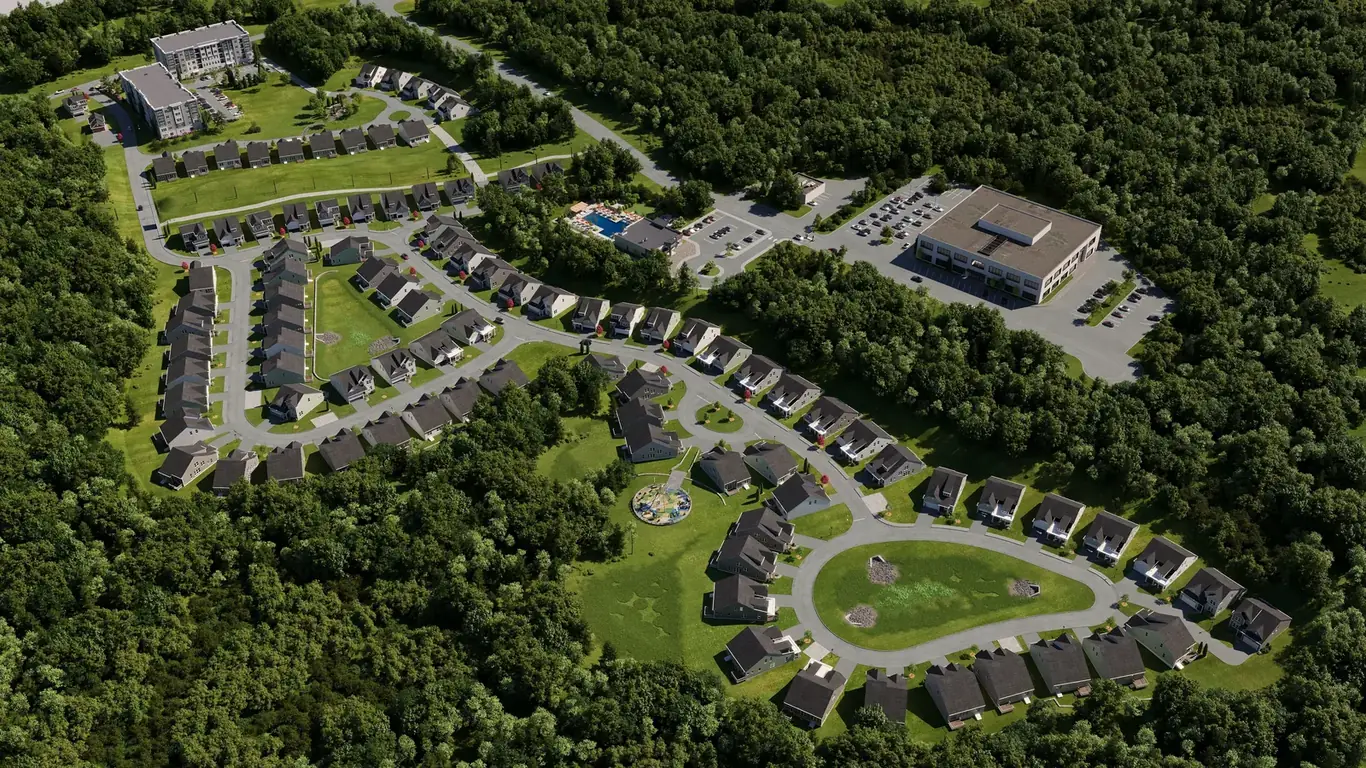
Apartment complex rendering serves more audiences than almost any other visualization category. Investors evaluating a deal want site context, unit mix clarity, and amenity quality. Planning boards want massing, materials, and neighborhood fit. Prospective tenants — the end users who determine whether the project actually leases up — want to understand what living there will feel like: light in the morning, the view from the terrace, how the kitchen reads at dinner on a Tuesday night.
The developers who get the most value from visualization plan the rendering package to serve all three audiences from the outset, rather than commissioning renders reactively when each stakeholder appears. The result is a tighter brief, a more coherent visual identity for the project, and a render set that works harder across its full lifecycle. This guide covers what that looks like in practice.
How apartment complex rendering differs from condo visualization
Most articles treat apartment and condo rendering as interchangeable. They're not, and the differences shape the entire brief.
Condo developers are running a one-time sales campaign with a defined closing horizon. They need deposit-driving visualization — high-emotional-impact renders designed to move a buyer from registered interest to signed purchase agreement. The pre-sales campaign ends when units are sold; the renders do their job once.
Apartment developers are running an ongoing leasing business. The visualization package needs to function as a long-term marketing asset across the full lease-up period — which can run 12–24 months after opening — and then continues working as the property's representation on ILS platforms, marketing materials, and brand assets for the life of the asset. The campaign never really ends. This changes the economics: spending more on visualization quality pays back over a longer horizon, and the renders need to age well rather than just spike conversion at launch.
The other key difference is what drives leasing decisions. Condo buyers are evaluating a specific unit they're purchasing permanently — finish quality and floor-level pricing matter enormously. Renters evaluate the complex as a place to live and move on from. Unit finishes matter, but the amenity offer and the sense of community the renders communicate are often the primary differentiator between a class of competing developments. For communities operated as a single rental asset, this leasing-first logic is even more pronounced — see our guide on 3D rendering for build-to-rent and multifamily leasing.
The visualization types a multifamily package needs
A well-planned apartment complex rendering package covers six asset types. The right set for any given project depends on scale, asset class, and how the project will be marketed — but understanding the full toolkit helps you allocate budget where it creates the most value.
Exterior renders show the building facade, street-level relationship, materiality, and landscaping. For a mid-rise or high-rise complex, plan for 2–3 exterior angles: a street-level hero view, a courtyard or amenity entrance, and at least one view that places the building in its neighborhood context. Garden-style communities spread across large sites need more exterior views because the site reads horizontally rather than from a single vantage.
Aerial renders show site organization, building massing, and the relationship between structures, parking, amenities, and surroundings. These are essential for investor presentations and planning submissions. For large multiphase communities — 300+ units across multiple buildings — an aerial render is often the only image that communicates the full scale and layout of the development. No street-level render can do what a well-composed aerial does for a garden-style or campus-format complex.
Amenity renders deserve more budget allocation in multifamily than most developers give them, for reasons discussed in the section below. Pools, fitness centers, co-working lounges, rooftop terraces, and pet facilities should each be rendered if they represent a meaningful leasing advantage over nearby competing buildings.
Interior renders show unit types — studio, one-bedroom, two-bedroom — furnished and finished to specification. These are used in pre-lease marketing, ILS listings, and any presentation where prospective tenants evaluate space and quality before construction is complete. The brief matters here: generic furniture and neutral finishes read as placeholder visualization, not a leasing advertisement.
3D floor plans — a top-down view of each unit layout — let prospective tenants understand spatial organization, flow, and proportions. They're standard in leasing brochures, property websites, and ILS listings for pre-leasing campaigns.
Animations — a 60–90 second flythrough of the site and key spaces — are used for high-investment presentations: investor day materials, city council submissions, and luxury-tier pre-leasing events. At $2,500–$6,000 for a 90-second piece, animations aren't standard for every project, but for a 200-unit luxury development in a competitive urban market, the investment is often justified by the per-screening impact at broker events and investor meetings.
Asset class and how it shapes the package
The right visualization package for a multifamily project depends heavily on asset class. Class A luxury, Class B value-add, and Class C workforce housing have different stakeholder expectations, different marketing budgets, and different definitions of what "good" looks like in a render.
| Asset class | Visualization priority | Package focus | Typical total spend |
|---|---|---|---|
| Class A — luxury | Amenity quality, finish standards, lifestyle positioning | Full package with premium quality: exterior, aerial, 4–6 amenity renders, 3–4 unit type interiors, animation optional | $15,000–$40,000+ |
| Class B — value-add | Before/after renovation, investor exit positioning | Exterior hero + aerial + 2–3 renovated unit interiors; emphasis on post-renovation quality versus pre-renovation condition | $6,000–$18,000 |
| Class C — workforce housing | Planning and community relations; equity investor presentations | Exterior contextual views for planning submissions + aerial; minimal interior renders | $3,000–$8,000 |
The value-add use case deserves specific mention. A developer acquiring an existing apartment building to renovate and reposition can use renders of the post-renovation state — new finishes, updated common areas, refreshed exterior — for the equity raise and lender presentations before any renovation work begins. These renders function identically to pre-construction renders in terms of what they accomplish, and the same brief and production process applies.
Why amenity renders are the primary leasing asset in multifamily
In condo pre-sales, interior renders drive decisions because buyers are purchasing a specific unit permanently. In apartment leasing, the calculus is different. A prospective tenant choosing between two buildings with similar unit finishes and similar rents is primarily deciding based on how they imagine their daily life at each property — and that image is shaped almost entirely by amenity renders, not unit interiors.
The amenity arms race in Class A multifamily has made this more true over the past decade. Most new luxury apartment buildings in competitive urban markets offer similar kitchen specifications, flooring, and appliances. The differentiator is the fitness center at 6am, the rooftop terrace on a Friday evening, the co-working lounge on a Monday morning. A well-rendered amenity sequence communicates that lifestyle directly and creates the emotional pull that converts a property tour into a lease application.
The practical implication for the brief: amenity renders should be planned as the primary leasing marketing assets, not as supplementary views. They should receive the same lighting attention, staging investment, and revision care as the exterior hero. A single poorly rendered amenity image — a pool deck with generic furniture, flat lighting, and an empty sky — can undermine the positioning of an otherwise compelling visualization package.
ILS platforms and format requirements
For apartment marketing, the ILS (internet listing service) channels — Apartments.com, Zillow, CoStar, Rent.com — are the primary discovery channels, and they have specific format requirements that should be planned into the brief.
Apartments.com accepts high-resolution JPEG images; their recommendation for property listings is a minimum of 1024×768 pixels, with 1920×1280 preferred. The hero image on an Apartments.com listing is displayed at a landscape 16:9 crop — if the exterior render wasn't composed with that crop in mind, the building entrance or key architectural feature may fall outside the frame. Zillow has similar landscape format preferences for its rental listings. CoStar, used primarily for larger multifamily assets and institutional landlords, often requires property images alongside floor plan documentation.
The practical implication: when briefing the studio, specify that renders will be deployed on ILS platforms and provide the target hero crop ratio (16:9 landscape is safe for most channels). This shapes camera positioning and composition choices at the brief stage at no additional cost — versus requesting re-composition after delivery, which adds revision time and fees.
Sequencing renders across the development timeline
The biggest efficiency gain in multifamily visualization comes from sequencing render types to match when each audience actually needs them.
- Entitlement and planning (schematic design). Planning boards need to evaluate massing, materials, and neighborhood context — not unit finishes. Commission exterior views showing facade treatment and street-level relationship, plus an aerial showing site organization. These don't need to be at full marketing quality; they need to be accurate and readable at planning submission scale.
- Investor and financing (schematic to design development). Equity investors and construction lenders are evaluating the asset. Commission the exterior hero, key amenity spaces, and representative unit interiors for each bedroom type. At this stage, updated schematic-level drawings are sufficient for exterior and aerial renders; interior renders need more resolved design documentation.
- Pre-leasing and marketing (design development to CDs). Once financing closes and construction is underway, the pre-leasing campaign begins. This is where interior renders, 3D floor plans, and polished amenity visuals come in — and where they'll be distributed most widely on ILS platforms, social media, and print.
- Lease-up through completion. As construction approaches delivery and actual photography becomes available, rendered visuals are gradually replaced. For large communities with multiple phases, phased rendering — updating visuals as each phase is designed — extends the useful life of the original investment.
Pricing and delivery timeline
| Render type | Price range | Delivery |
|---|---|---|
| Exterior (per view) | $799–$2,000 | 5–8 days |
| Aerial / bird's-eye | $999–$2,500 | 7–10 days |
| Amenity space (per view) | $600–$1,400 | 5–7 days |
| Interior / unit (per view) | $399–$900 | 3–5 days |
| 3D floor plan (per type) | $349–$700 | 3–5 days |
| Animation (90 sec) | $2,500–$6,000 | 2–3 weeks |
A typical investor-ready package for a mid-rise apartment complex — 3 exterior views, 1 aerial, 2 amenity renders, 3 unit type interiors, 2 floor plan types — runs $6,000–$12,000 depending on complexity and documentation completeness at brief stage. A full Class A marketing package runs $15,000–$40,000 for a 150–250 unit development.
What to provide for a multifamily brief
The quality of the renders a studio produces scales directly with the completeness of the documentation you provide. For an apartment complex, minimum requirements are:
- Site plan with building footprints, parking, landscaping, and north orientation
- Floor plans for each building type with confirmed dimensions and unit layouts
- Exterior elevations (all sides) for each building type
- Material and finish specifications — cladding, windows, balconies, roofline treatment
- Unit interior finish schedule — flooring, countertops, cabinetry, fixtures
- Amenity program documentation with furniture and equipment indicated
- Reference images for design positioning and lifestyle target
- ILS platform requirements if renders will be used on listing channels
If full construction documents aren't ready, schematic-level drawings with a detailed verbal brief are enough to start exterior and aerial renders. Interior renders need more resolved documentation — unit layouts, ceiling heights, and finish selections — before production begins.
Our exterior rendering and aerial rendering services are commonly used together for multifamily projects. For full-package pricing and scope estimates, see our pricing page — we turn around estimates within 2 hours of receiving your drawings.
Working on a multifamily development?
Send us your site plan and drawings — we'll scope a visualization package with pricing within 2 hours.
Request a Free Estimate