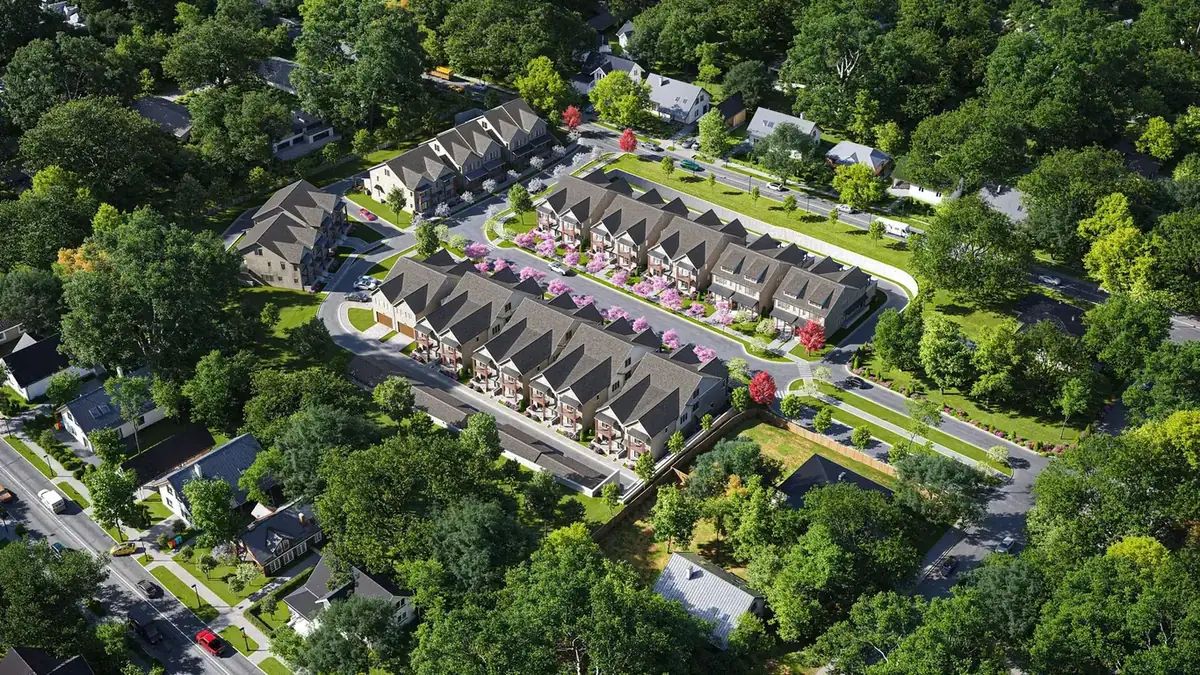
Student housing is a notably competitive niches in multifamily real estate development. Purpose-built student accommodation (PBSA) projects compete for the same student pool on the basis of amenities, location proximity to campus, and the lifestyle they project — and that lifestyle has to be communicated before a single bed is available to view. 3D rendering is how PBSA developers do that marketing, and it shapes outcomes at every stage from equity raise to lease-up.
The challenges in student housing visualization are distinct from standard multifamily. The primary buyer of the story isn't always a single investor reviewing a pro forma — it's often a combination of institutional capital, university housing offices, and student residents who all respond to different aspects of the same project. A rendering that works for an investor pitch needs different emphasis than one that drives a student to submit a lease application. Understanding how to structure the visualization package for student housing is the difference between a marketing suite that works and one that underperforms.
Why Student Housing Renders Differ from Standard Multifamily
In standard multifamily, the marketing focus is typically split between the unit interior and the building exterior. Amenities are secondary. In purpose-built student accommodation, the amenities are often the primary purchase driver — students choose PBSA over off-campus rentals specifically for what the building offers beyond the bedroom.
This means the visualization priority order is different. A well-constructed PBSA render package will spend as much or more effort on the communal spaces — the study lounge, the co-working area, the gym, the social kitchen, the rooftop terrace — as it does on the individual unit. Students make decisions based on how the building makes them feel as a social environment, not just whether the bedroom has a window and a desk.
The unit itself still matters, but the emphasis within unit renders shifts. En-suite rooms need to feel space-efficient without feeling cramped. Studio units need to demonstrate that a compact footprint can still deliver a comfortable, functional living environment. These are rendering challenges that require careful lighting, thoughtful furniture staging, and camera angles that maximize perceived space without being misleading.
The Standard PBSA Render Package
For a student housing development going through financing and pre-leasing simultaneously, the typical render deliverable set covers five categories of views:
Exterior hero view. The building's primary street elevation, photographically styled to show the building at its best — typically dusk or golden-hour lighting, active streetscape with pedestrians, and any ground-floor activation (retail, café, lobby entrance) shown as live. This is the marketing hero image that anchors all other collateral.
Aerial or bird's-eye view. For larger PBSA projects — particularly those on campus-adjacent sites or as part of mixed-use schemes — an aerial view establishes site context, shows the building's relationship to the university campus, and communicates scale. For aerial rendering, the view angle and altitude matter significantly: you want to show the site in context without making the building look small.
Communal amenity renders. The amenity package should include renders of the study lounge or co-working space, the gym or fitness area, the social kitchen or communal dining area, and any signature amenity — a rooftop terrace, a gaming lounge, a cinema room — that differentiates the project. Each amenity render should be populated with lifestyle figures showing the space in active use.
Unit type renders. For a project with three or four unit configurations — studio, en-suite, shared flat — a render of each unit type at its best. En-suite rooms should be shot to maximize the sense of space and natural light. Studios should be staged to show the full functionality of the layout. These renders serve both student leasing and investor underwriting.
Corridor and circulation renders. Often overlooked but important for student housing: the building's circulation — corridors, elevator lobbies, bike storage, entrance lobby — communicates the quality level of the project in ways that purely room-focused renders miss. A well-rendered entrance lobby signals the overall standard of the development.
Securing Financing and Institutional Capital
Institutional investors in PBSA — student housing REITs, value-add funds, university endowments acquiring ground-lease assets — evaluate projects at the concept stage with some version of a development pitch that includes visualizations. The visualization quality is a signal about the developer's preparation and attention to detail, and poor-quality renders can undermine an otherwise strong pro forma.
For investor-facing renders, the key emphasis is different from student-facing marketing. Investors respond most to: the exterior that establishes the development's market positioning (mid-market versus premium), the amenity package that justifies the rent premium, and the unit layouts that demonstrate efficient net-to-gross ratios. Floor plan renders — whether 3D floor plan views or furnished unit plan overlays — are particularly useful in investor presentations because they communicate the unit mix and layout efficiency in a single image.
Our 3D floor plan rendering service is frequently used by PBSA developers to show unit layout options and demonstrate how the floor plate achieves the density and amenity balance the pro forma requires.
Student Pre-Leasing Marketing
Pre-leasing is the most important commercial outcome for most PBSA developments. A building that opens 80% leased has a fundamentally different financing cost structure than one that opens at 40%. 3D visualization is the primary tool for driving pre-leasing commitments in a market where students are making accommodation decisions 6–12 months before move-in.
Student marketing renders need a different quality of storytelling than investor renders. They need to show the building as a place where students will enjoy living — not just a well-specified property. This means: populated amenity scenes with students working, socializing, and exercising; natural daylight in unit renders that feel warm and inviting; communal spaces that look genuinely used rather than sterile.
The social kitchen or communal dining area is consistently an effective renders in student marketing. It shows the building as a community, not just a collection of individual bedrooms. For Gen Z students who have grown up with social media and are acutely sensitive to the social environment of wherever they live, this framing matters.
View Set for a Typical 200-Unit PBSA Project
| View | Purpose | Typical Cost |
|---|---|---|
| Exterior hero (dusk) | Marketing anchor / investor deck | $800–$1,200 |
| Aerial context view | Site context / planning | $900–$1,400 |
| Study lounge / co-working | Lead student amenity | $700–$1,000 |
| Social kitchen / dining | Community storytelling | $700–$1,000 |
| Gym / fitness | Amenity marketing | $700–$1,000 |
| En-suite unit (per type) | Lease conversion | $600–$900 |
| Entrance lobby | Brand / quality signal | $600–$900 |
A complete package for a 200-unit PBSA development typically runs $5,000–$9,000 for 8–10 views covering all the categories above. Full pricing guidance is available on our pricing page.
Technical Challenges in Student Housing Visualization
Student housing has specific technical challenges that studios without PBSA experience sometimes handle poorly.
En-suite room proportions. En-suite rooms are typically small — 12–18 square meters is common. Rendering them without making them look cramped requires careful wide-angle framing, window placement that emphasizes natural light, and furniture that's correctly scaled to the compact footprint. Over-staging a small room with too much furniture makes it look cluttered; under-staging makes it look cold and empty.
Communal space animation and population. Communal spaces need to feel active and social to tell the right story. Empty study lounges and vacant social kitchens undermine the community narrative. Populated scenes with correctly scaled and lit lifestyle figures — not floating or stiff digital mannequins — require experience with people placement in interior scenes.
Rooftop and outdoor amenities. If the project has a rooftop terrace or courtyard, these views need to show the outdoor space in context — the campus or urban environment beyond, the quality of the outdoor furniture and landscaping, and the connection between the indoor and outdoor amenity experience. For LA-based PBSA projects, the outdoor amenity is often a stronger marketing asset than the indoor gym, because the climate supports year-round outdoor use.
Planning Applications and University Partnerships
PBSA projects in California — particularly those within university communities or adjacent to established residential neighborhoods — often face more complex planning and neighborhood approval processes than standard multifamily. Community meetings, design review boards, and university planning approval processes all require visualization that communicates the project's design quality and contextual fit.
For these applications, the render requirements are different from marketing renders. Planning renders prioritize daylight hours, neutral lighting, and a factual representation of massing and materials rather than optimized marketing angles. They often need to be accompanied by streetscape context renders that show the project in its existing neighborhood setting. See our article on rendering for permit applications for a full discussion of planning-specific render requirements.
For a broader look at how multifamily developers use visualization across the development lifecycle, see our article on apartment complex 3D rendering.
Developing a Student Housing Project?
Share your floor plans and amenity program — we'll scope a PBSA render package with pricing within 2 hours.
Request a PBSA Package Quote