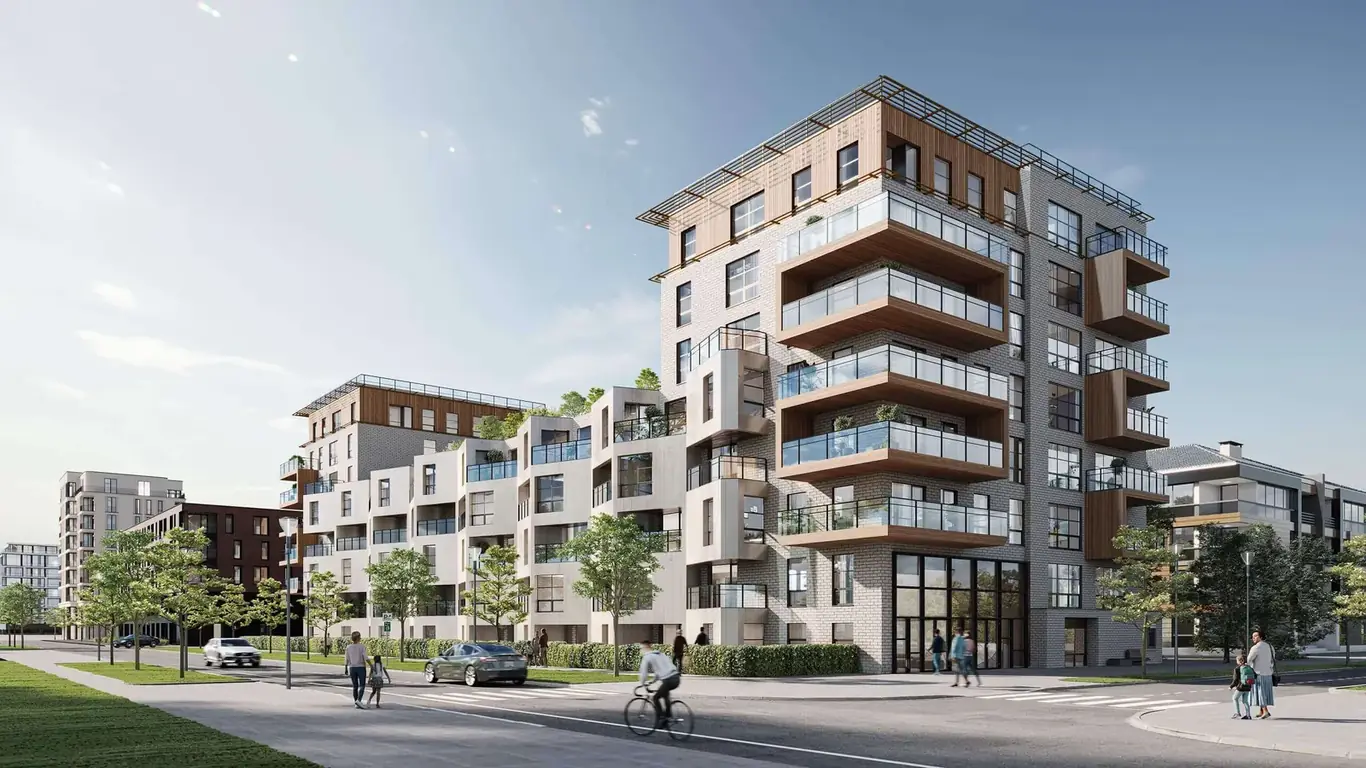
Affordable housing development is not a marketing-driven business. Most affordable rental projects are built on competitive capital — Low-Income Housing Tax Credits, local NOFA loans, AHP grants, and layered public financing — and every significant funding source requires some combination of drawings, elevations, floor plans, and design narrative before money is committed. Renderings don't win LIHTC applications by looking polished. They win by making required documentation faster and easier for reviewers, loan committees, and planning staff to understand.
That distinction is important. No state housing finance agency I've reviewed scores a standalone "rendering quality" criterion. What agencies score are things like readiness, amenity commitments, design compliance, affordability depth, and accessibility. Strong visualization supports all of those categories — not by being pretty, but by making complex project information legible under competitive pressure. In California and Los Angeles especially, where affordable housing sits at the intersection of competitive capital, streamlined planning law, and intense neighborhood scrutiny, the argument for professional visualization early in predevelopment is unusually strong.
Why affordable housing runs on competitive capital — and why that changes everything
The Low-Income Housing Tax Credit is the dominant production tool for affordable rental housing in the United States. HUD describes LIHTC as the country's most important resource for creating affordable rental housing, with state and local allocating agencies receiving approximately $12 billion in annual budget authority to issue credits. HUD's LIHTC database now covers 55,345 projects and 3.9 million housing units placed in service between 1987 and 2024 — a program scale that dwarfs any other single affordable housing mechanism. Tax Policy Center estimates put LIHTC production at about 87,000 units per year on average from 2012 to 2021, with roughly 156,000 units financed in 2021 when both 9% and 4% activity were strong.
The housing need that program serves is enormous. NLIHC's 2026 Gap report documents a nationwide shortage of approximately 7.1 million affordable and available homes for extremely low-income renter households, with only about 35 affordable and available homes for every 100 extremely low-income renters nationally. In California alone, HCD estimates the state needs more than 2.5 million homes by 2030, including at least 1 million for lower-income households. Los Angeles County's RHNA allocation for 2021–2029 is approximately 812,000 units countywide, with the unincorporated county alone responsible for 90,052 units including 39,339 very low- and low-income homes.
The capital structure matters because it creates the commercial logic for visualization investment. 9% LIHTC is competitive by design — states receive a fixed credit ceiling and allocate it through scored applications. The Federal Home Loan Bank's Affordable Housing Program is competitive by federal regulation. Major California and Los Angeles-area NOFAs are competitive. When funding is limited and applications are scored, every element of a submission — including how clearly it communicates design quality, amenity commitments, and neighborhood fit — has consequence. Visualization is a predevelopment soft-cost tool, not a marketing luxury, and it should be budgeted and timed accordingly.
What state agencies actually require — and the gap between minimum and competitive
The clearest finding from reviewing state HFA application requirements across seven major states is this: agencies consistently require enough architectural documentation to make renderings feasible, but they rarely use the word "rendering" in their scoring criteria. The competitive advantage lies in the gap between what is formally required (plans, elevations, floor plans) and how well those materials communicate under real application conditions.
None of the agencies reviewed — California TCAC, Texas TDHCA, New York HCR, Florida Housing, Washington WSHFC, Colorado CHFA, or Illinois IHDA — scores a standalone "rendering quality" criterion. The competitive advantage is more specific: strong visuals make the required architectural documentation faster to evaluate and harder to question. The table below shows what each agency actually requires and where that creates leverage.
| Agency / state | What the rules require visually | Where renderings create competitive leverage |
|---|---|---|
| California TCAC | Construction and design description; preliminary drawings: site plan, building elevations, unit floor plans; architect accessibility certification | Amenity commitments and design compliance are scored categories — renderings make those commitments visually verifiable rather than just described in narrative |
| Texas TDHCA | Architectural plans by type, building elevations; architect and accessibility certifications | Exterior views and amenity visuals support scored amenity categories and make the application easier to assess against competing submissions |
| New York HCR | D-1 Preliminary Plans: site plans, building plans, building elevations; technical-assistance session typically required before main application | Early architectural clarity is unusually critical because applicants must be ready before the formal round opens — strong visuals at the technical-assistance stage signal readiness |
| Florida Housing | Site plans and architectural drawings that support all promised amenities; DRC underwriting checks visual-narrative consistency | Drawings must match every amenity claimed in the application — renderings reduce underwriting deficiency findings by making that alignment obvious |
| Washington WSHFC | Elevations, typical floor plans, descriptive sections, site plan, and roof plan — required for both 9% and 4% applications | WSHFC's early visual package requirement means renderings fit naturally as an upgrade on materials the architect is already preparing |
| Colorado CHFA | Schematic drawings, elevations, site plan, and floor plans (both 9% and 4%) | Schematics are baseline — exterior and aerial renderings upgrade the same materials with better spatial clarity for reviewers evaluating site fit and density |
| Illinois IHDA | Dimensioned floor plans, exterior elevations, site plan; accessibility/adaptable-unit information and coordinated interior elevations required in drawing checklist | Illinois has the most technically demanding drawing checklist reviewed — a rendering studio helps package that required material into a submission that reads clearly rather than just technically |
California and Los Angeles: where visualization is embedded in the capital process
California is the most important geography for affordable housing visualization work, not because its rules are more explicit about renderings, but because the capital stack, political environment, and streamlining framework all create stronger arguments for early visual documentation than anywhere else in the country.
TCAC applications require preliminary architectural drawings inside the submission itself — site plan, building elevations, and unit floor plans are threshold materials, not optional attachments. This means visualization timelines must align with application deadlines, which are months ahead of when a market-rate developer would typically commission serious rendering work. The implication for affordable housing development teams: rendering procurement needs to be on the predevelopment budget from day one, not added when the project feels "real enough."
LAHD and LACDA add another layer specific to Los Angeles. The Los Angeles Housing Department's architectural guidelines explicitly describe the objective as producing "well-designed, quality, affordable housing in a cost-effective manner." LAHD has historically tied architectural review to financing commitments — design review is described as "an important step" in acquiring LAHD financing. LACDA's NOFA materials are even more explicit: they establish a formal NOFA Application Phase for schematic design threshold review and a Loan Committee Phase for review of drawings and specifications. For Los Angeles affordable housing projects, visuals are not peripheral to the capital process — they are reviewed at both the application and loan committee stages.
California's streamlining laws don't eliminate the need for strong visuals — they change it. Under SB 35 and related Government Code provisions, qualifying housing developments can receive ministerial approval, bypassing discretionary hearings, if they satisfy applicable objective planning standards. Under AB 2162, supportive housing is a use by right in qualifying zones, subject only to objective development and objective design review standards. Under AB 2011, eligible housing on commercial sites can receive ministerial approval under HCD's objective frontage, setback, parking, and site-planning standards. Under AB 2097, minimum parking requirements are limited or prohibited near major transit stops.
The practical implication of streamlining: when discretionary hearings are reduced, the project still has to demonstrate compliance with objective standards — and it has to do so quickly, on paper, to staff reviewers rather than planning commissioners. A site plan rendering, streetscape view, or aerial showing parking, massing, and circulation relative to transit infrastructure can demonstrate AB 2011 and AB 2097 compliance faster than any written narrative. The Los Angeles TOC program, which grants density bonuses near transit, adds another layer: its explicit goal of producing affordable and mixed-income housing "while minimizing impacts to existing neighborhood character" is exactly the brief for contextual streetscape and neighborhood-fit visuals.
The community engagement layer: where absent visuals lose projects
Community opposition is one of the most consistent sources of delay and cost in affordable housing development, and visualization is one of the few tools that actually addresses its root cause. Research on affordable housing opposition consistently shows that public concern is often driven not by fundamental opposition to affordable residents but by confusion — about what the project will look like, how tall it will be, what the materials are, how many parking spaces will be provided, what amenities residents will have, and whether the building will fit the neighborhood.
Design-centered community engagement toolkits specifically recommend clear visual communication as a way to address these concerns at their source. I'm careful not to overclaim here: renderings do not neutralize politically motivated opposition, and I haven't found published evidence that a better rendering alone changed a LIHTC score or planning outcome. But the pattern is consistent enough to draw a practical conclusion: absent visualization leaves opponents free to imagine the worst. A developer presenting schematic CAD drawings at a community meeting is asking the audience to fill in the visual gaps themselves. That gap is where opposition narratives form.
Exterior contextual views showing the building at street level, massing studies showing height relative to existing neighbors, and amenity visuals showing the courtyard, community room, or landscaping all address specific concerns that appear repeatedly in opposition testimony. They don't substitute for genuine community engagement, but they give that engagement a shared visual foundation rather than competing imaginations.
What types of renderings matter at each development stage
Affordable housing projects benefit from different visualization types at different stages, and matching the rendering type to its actual use in the process is how development teams avoid paying for visuals that arrive at the wrong moment.
Predevelopment and funding applications: The highest-leverage renders at this stage are the exterior elevation and site or aerial view. These directly serve the plans-and-elevations requirements that every reviewed state HFA includes in its application checklist. A clean, well-organized exterior render with accurate massing, materials as specified, and visible site context gives reviewers what they need to evaluate the design narrative quickly. For projects with significant open space, landscaping, or common areas, amenity renderings can support the amenity commitments that some agencies score directly.
Entitlements and planning approvals: Streetscape and contextual exterior views are most relevant here. Under California's streamlining framework, the goal is demonstrating objective standard compliance — setbacks, frontage treatment, ground-floor activation, parking configuration — in a format planning staff can evaluate in minutes rather than hours. An aerial view showing the project's relationship to surrounding transit infrastructure serves AB 2097 and TOC analysis directly.
Community engagement: Ground-level pedestrian views showing how the building meets the sidewalk, common courtyard and open-space renderings, and views from adjacent residential streets are most effective at reducing visual ambiguity. The goal is answering the specific questions neighbors ask at public meetings, not impressing design reviewers.
Investor and committee presentations: Interior renderings of representative units and community amenity spaces — community rooms, children's play areas, laundry facilities, lobby spaces — help investor committees and lender underwriting teams understand what the project actually delivers for residents. This is especially relevant for supportive housing and senior projects where programmatic clarity about resident experience is part of the evaluation.
Lease-up and pre-occupancy marketing: Exterior views, floor plan visualizations, and representative unit interiors serve the pre-leasing and lottery outreach phase. These materials must be carefully produced to comply with fair housing requirements — discussed separately below.
The design quality shift: affordable doesn't mean generic
One of the most commercially important changes in the affordable housing sector over the past decade is the shift in how public funders describe what they're trying to build. Los Angeles County Development Authority's architectural requirements now explicitly state that their purpose is to produce "high quality affordable housing" and encourage "innovative and creative design solutions." LAHD's architectural guidelines use nearly identical language, describing the objective as "well-designed, quality, affordable housing in a cost-effective manner." These are not aspirational marketing statements — they are formal descriptions of what LA's most active affordable housing funders say they are paying for.
The recent award record reflects this. La Prensa Libre Apartments in Los Angeles — a 105-unit, 100% affordable development serving households up to 60% AMI, developed by AMCAL with WHA Architects in partnership with the Coalition for Responsible Community Development — received a Housing Projects: Multi-Family Affordable Award in 2024. Berkeley Way Apartments in Berkeley, developed by BRIDGE Housing and Insight Housing with Leddy Maytum Stacy Architects, won an AIA Housing Award in 2024. LOHA's Isla Intersections Supportive Housing received an AIA Los Angeles Residential Architecture Award in 2025. These projects were recognized not despite being affordable housing but as architecture — the same categories and criteria applied to market-rate work.
For a rendering studio, the practical implication is that the brief for an affordable housing project is not "make it look acceptable." It's the same brief as any serious multifamily commission: communicate the design intent accurately, show how the building meets its site, and make the materials and massing legible to the full range of stakeholders who need to approve and support it. The audience is more diverse and the stakes are higher — a competitive funding application where a reviewer makes a judgment in minutes rather than a marketing campaign where a buyer browses at leisure — but the standard of visual clarity is the same or higher.
Accessibility and fair housing: two rendering requirements nobody talks about
Affordable housing developments almost always include accessibility requirements that go beyond the baseline of the ADA — and those requirements are verifiable in design documentation. California TCAC requires the project architect to certify compliance with building codes and applicable housing and accessibility requirements. LACDA's NOFA design requirements contain dedicated accessibility and universal design sections. Illinois IHDA requires accessible and adaptable unit information and coordinated accessibility features in interior elevations. New York HCR ties 9% LIHTC commitments to mobility and hearing/visual accessibility. In all of these cases, the accessibility documentation is part of the funding application, not an afterthought.
The rendering implication: accessible routes, elevator lobbies, roll-in showers, wider doorway clearances, accessible parking configurations, and age-in-place unit features should be shown accurately in renderings rather than approximated with generic imagery. A reviewer or underwriter who needs to verify accessibility compliance benefits from visuals that make those features legible — the same way they benefit from visuals that make massing and amenities legible. An interior rendering of an accessible unit that actually shows the turning radius, the grab bar placement, and the roll-in shower configuration communicates more clearly than any written accessibility narrative.
Fair housing compliance creates different but equally important constraints on marketing imagery. Federal regulations make it unlawful to publish an advertisement indicating a preference, limitation, or discrimination based on a protected class. HUD-related advertising guidance states that human models in photographs or drawings cannot be used in a way that implies exclusiveness or limited welcome to particular groups. For affordable housing pre-leasing materials, renderings must show inclusive, non-exclusionary imagery — not exclusively one family type, one age cohort, one ability status, or one racial presentation. This isn't just a legal precaution; it's what the funding program actually requires. Developers who brief their rendering studios on these constraints before production avoid corrections and retakes.
How to time rendering procurement in affordable housing development
The most consistent mistake I see affordable housing development teams make with visualization is treating it as a late-stage deliverable — something to commission once the project feels "real." In affordable housing, the project becomes real through competitive funding rounds that require visual documentation before money is committed. Timing rendering procurement correctly means working backward from application deadlines, not forward from construction starts.
A practical framework for California projects:
- At site control: commission schematic massing studies, site plan, and aerial view — enough to support a preliminary application narrative and establish the design concept with early stakeholders
- 8–12 weeks before application deadline: commission the exterior elevation render(s), amenity visuals, and any accessible unit interior needed to support the TCAC or NOFA submission package
- Before community outreach meetings: commission the streetscape and contextual pedestrian views that address the specific visual concerns of the neighborhood — massing relative to neighbors, open space, parking treatment
- Before loan committee and investor presentations: commission representative unit interiors and community amenity spaces that communicate resident experience to underwriting reviewers
- Before lease-up lottery: commission fair-housing-compliant exterior and unit renders for the project website, brochure, and lottery marketing materials
The budget for these materials belongs in the predevelopment soft-cost line, not the marketing budget. For projects using exterior rendering and aerial visualization, the investment is recoverable many times over in the competitive capital it supports. For a full picture of what professional rendering delivers at each stage, see our guide on what to expect from a 3D rendering studio, and our pricing page for how we scope and estimate these projects.
Working on an affordable housing project in California?
Send us your project details — we'll scope a rendering package aligned to your application timeline and deliver a free estimate within 2 hours.
Request a Free Estimate