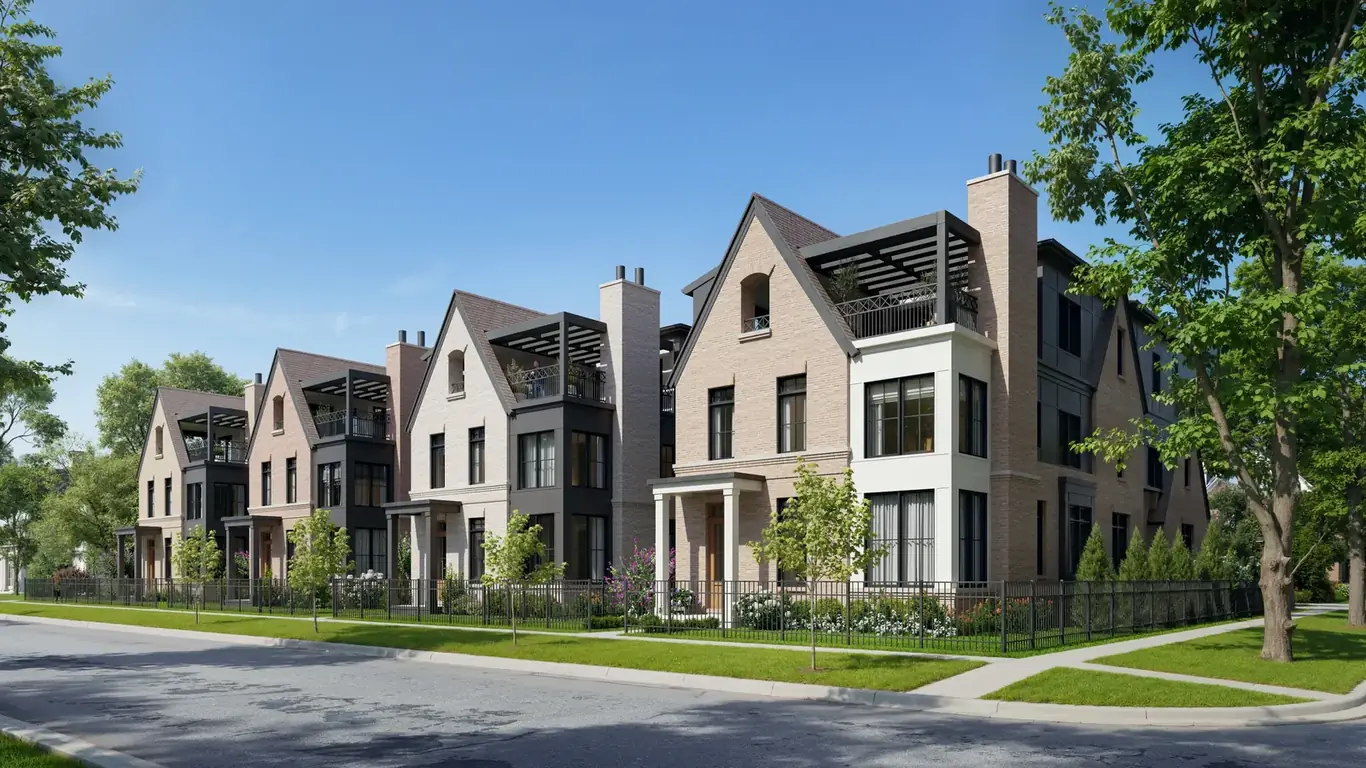
Townhouse projects present a specific visualization challenge: you're selling individual homes that are physically attached to each other, in a format where the design differentiation between units is often subtle. The streetscape render that shows the full row needs to communicate variety and quality without looking repetitive. The interior renders need to show a livable, aspirational space that will sell every unit, even though each unit has slightly different proportions, views, and access to light.
In my experience, the developers who get townhouse visualization right think carefully about which views serve which purpose — and resist the impulse to render everything. A focused package of six to eight carefully chosen views will outperform a sprawling set of twenty renders where half aren't doing useful work. This guide covers the standard townhouse view set, what each view is for, how to brief interior renders for attached homes, and what to expect on pricing.
The Townhouse Visualization Challenge
Attached housing has specific visual constraints that detached single-family and multifamily apartment rendering don't share:
Showing the row without looking repetitive: A row of ten identical townhouses doesn't sell the way ten distinctive homes would. The exterior render needs to communicate the streetscape quality while using architectural variation — different materiality treatments per unit, staggered setbacks, varied roofline elements, varied entry expressions — to create visual rhythm. A render that makes the row look monotonous actively hurts the marketing, even if the design itself has variety that the angle doesn't show.
Vertical stacking of program: Townhouses are tall and narrow. Buyers need to understand how three or four levels of living space connect — where the kitchen is in relation to the living room, how the bedroom floors relate to the entry, whether the rooftop terrace is accessible. This is harder to communicate in a standard rendered view than it is for a single-story home or a horizontal apartment.
Private outdoor space: For many buyers, the backyard, courtyard, or rooftop terrace is the reason to choose a townhouse over an apartment. This space is often not visible from the street-level exterior render. It needs its own view.
The Standard Townhouse View Set
A complete visualization package for a townhouse development typically includes these views:
Streetscape / row view (exterior): The primary marketing exterior — a slightly elevated perspective that shows three to five units in the row with street, sidewalk, and landscaping. This view communicates design quality, material quality, and neighborhood context. It's the image that goes on the project website, the sales brochure, and the hoarding. For a row of ten or more units, you may need two streetscape views showing different segments to avoid excessive repetition in the frame.
End unit exterior: If there are end units with different facade treatments — a corner condition, additional windows, different materiality — they warrant a separate exterior view. End units often have more light and more character, and they're typically premium-priced; showing them specifically supports that pricing.
Private outdoor space: A render of the rear courtyard, garden, or rooftop terrace is frequently the most important view after the streetscape. Urban townhouse buyers are specifically paying for private outdoor space that apartment dwellers don't get. Show it well. Include furniture, planting, and appropriate context — adjacent units visible in the background, city views if applicable.
Living/kitchen/dining open plan: The principal interior view. Most townhouses have the main living floor at level 2 (above garage or ground-level entry), with an open plan connecting kitchen, dining, and living room. This is the highest-value space and the one that does the most selling work in interior marketing. Show it with natural light, quality finishes, and furniture that matches the target buyer — urban professional, young family, or empty-nester.
Primary bedroom: The second interior view, almost always the primary bedroom. For townhouses with rooftop terraces, consider whether the bedroom can show the terrace access through glass doors — this can do double duty.
3D floor plans: Multi-level townhouses are hard to understand from rendered views alone. A 3D floor plan showing each level separately — ground/entry, main living floor, bedroom floor, rooftop if applicable — helps buyers understand the vertical organization of the home before they visit. These are essential for online listings and should be included in any pre-sales package. See our guide on 3D floor plans for format options.
Aerial context view (for larger developments): For townhouse communities with common amenities — a community park, shared parking, a landscaped entry drive — an aerial view helps buyers understand the overall development layout. For small infill townhouse projects (6–10 units), this is often unnecessary; the streetscape view provides sufficient context.
Interior Rendering Strategy for Attached Homes
Townhouse interior rendering has one important strategic consideration that apartment rendering doesn't: the render of one unit type needs to sell all units.
For a development with two or three unit types, commission interior renders for the most popular type (usually the middle unit, as it tends to be the most numerous), and ensure the finishes shown represent the standard specification — not an upgraded package that most buyers won't pay for. If you're offering a high-grade upgrade option, render it separately and clearly label it as an upgrade in marketing materials.
For a development where all units are identical, the interior renders can be produced once and used for all marketing across the project. The cost savings compared to rendering each unit separately are significant — this is one of the structural advantages of townhouse visualization over mixed-use or multifamily projects with many unit types.
Art direction matters considerably. The furniture and lifestyle staging in townhouse renders should match the buyer profile precisely. A development targeting young professionals needs a different aesthetic than one targeting growing families. Studios that pull furniture from generic asset libraries often produce renders that feel aspirationally correct but demographically off — if the target buyer is a family of four, the dining table needs more than two chairs.
Pricing for Townhouse Rendering
A standard townhouse visualization package — two exterior views, one outdoor space view, two interior views, and 3D floor plans — typically runs $4,500–$9,000 depending on complexity and whether a 3D model exists.
| View Type | Price Range | Notes |
|---|---|---|
| Exterior streetscape | $799–$1,800 | Higher for larger rows |
| Private outdoor space | $500–$1,200 | Exterior or semi-exterior |
| Interior view (per view) | $399–$900 | Living area commands higher |
| 3D floor plan (per level) | $349–$700 | 3–4 levels typical |
| Aerial context view | $999–$2,500 | For larger developments only |
Package pricing for a complete six-view townhouse brief is typically 15–20% less than individual view pricing. For a full pricing breakdown, visit our rendering pricing page or request a project estimate — we respond within 2 hours.
Townhouse vs. Single-Family: Key Differences in Briefing
If you've commissioned rendering for detached single-family homes before, townhouse briefing has a few differences worth noting:
You need to model the context of adjacent units, not just the unit being rendered. A streetscape view requires all units in the visible row to be modeled, even if only one unit's interior is being presented. The exterior brief is therefore larger than it would be for a detached home.
Ceiling heights in townhouses are often lower than in detached homes — particularly on upper floors where roof pitch affects usable space. Make sure your brief includes ceiling height information for each level; inaccurate ceiling heights are a common sources of revision requests in townhouse interior renders.
Party walls affect light. The windows available to each unit type are constrained by the attached condition. Interior renders should show accurate light from the available windows — not ideal daylight assumed for a freestanding home. For more on the technical side of interior render briefing, see our article on interior rendering for architects.
Our exterior rendering and interior rendering services handle both aspects of townhouse visualization. For similar residential project types, see our guides on single-family home rendering and luxury residential rendering.
Planning a Townhouse Development?
Share your drawings and unit mix — we'll scope a full visualization package with pricing within 2 hours.
Request a Free Estimate