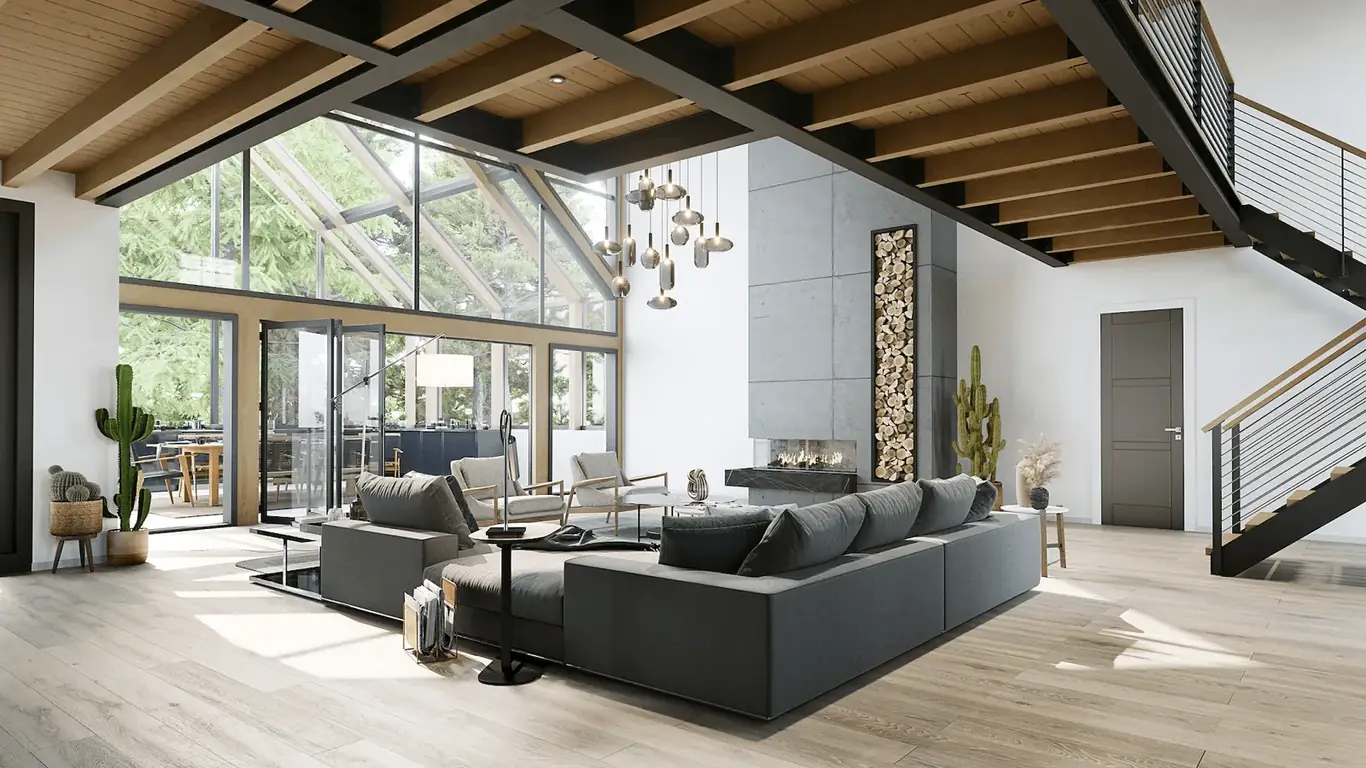
Interior designers face a communication problem that architects largely don't: their client is also their end user. The developer who commissions a building exterior may never live in it. The homeowner who commissions a living room redesign is going to sit in that room every day. The emotional stakes of alignment are higher, and the consequences of misalignment — returns, cancellations, rework — land directly on the designer's relationship with the person across the table.
Photorealistic 3D rendering is the most reliable solution to this problem. When a client can see the finished room before a single piece of furniture is ordered, the approval process becomes a confirmation rather than a negotiation. In my experience working with interior designers across residential and commercial projects, the designers who integrate rendering into their standard process close more proposals, run fewer revision cycles, and build stronger client relationships.
This guide covers the specific mechanics of how that works — where in the design timeline renders deliver the most value, how they change the client conversation, and what you need to brief a studio to get usable results quickly.
The Communication Gap Renders Solve
Every interior design project has a fundamental communication gap built into the process. The designer can see the finished room in their mind: the way afternoon light from a west-facing window will warm the oak flooring, the way a deep green sofa will anchor the space without overwhelming it, the way brass hardware will create a material thread between the kitchen and the adjacent living area. The client cannot see any of this until it's built.
Mood boards and material samples help close this gap, but they don't close it fully. A mood board is a collage of inspiration — it communicates direction, not outcome. A client looking at fabric swatches and paint chips is still doing significant imaginative work. And that imaginative work is where misalignments hide. The client thinks the green they approved is sage; the designer specified forest. They thought the brass was a light champagne; the studio sourced a deep antique gold.
A photorealistic render shows the room. The actual furniture in the actual room, the materials as they read at scale in that specific light, with those specific adjacent finishes. When the client sees it and says "yes, exactly that" — the project is aligned. When they say "I thought that wall color was going to be softer" — you've caught a problem that would have cost ten times more to fix after painting.
According to recent data, 82% of homeowners and design clients now expect interior visualization before committing to a design direction. Designers who don't offer it are increasingly at a disadvantage in competitive proposal situations.
Three Moments Where Renders Deliver Maximum Value
Not every project moment calls for a render. The designers who get the best ROI from visualization are deliberate about where in the timeline they commission it. In my experience, three moments produce disproportionate returns.
At the Proposal Stage
A designer who presents a proposal with renders wins more work than one presenting with mood boards and samples alone. The render makes the concept concrete. Two firms are often competing for the same project with similar qualifications and comparable pricing — the one who showed the client an actual room will almost always make the stronger emotional impression.
Proposal renders don't need to be production-quality final deliverables. A focused single view showing the key design concept — the main living area, the primary bedroom, the kitchen — is often enough to distinguish your proposal. The investment is typically $300–$600 for a single view that might close a $50,000–$200,000 project. Our interior rendering service is specifically structured for fast turnarounds to support proposal timelines.
Before Procurement
This is the most cost-critical moment for renders in the interior design process. Once you're ready to place furniture orders and commit to finishes, a render confirming the full composition — all materials together, final lighting, actual furniture pieces in their actual positions — can catch misalignments before they become expensive procurement errors.
A render at this stage typically costs $400–$800. A single furniture piece cancelled and restocked often runs $200–$1,000 in fees, depending on the vendor. A wall repainted after client objection to the installed color involves labor, materials, and schedule disruption. The math on pre-procurement rendering is straightforward: it almost always pays for itself on the first prevented correction.
For Complex Material and Spatial Decisions
Any time a client is being asked to approve something they'll find genuinely hard to visualize — a dramatically patterned tile in a large format, a bold paint color on a specific wall, an unusual spatial arrangement — a targeted render replaces a lengthy back-and-forth with a single image. The question "does this work?" becomes answerable in visual terms rather than as an exercise in mutual imagination.
These targeted renders can be surprisingly efficient to produce because they often don't require re-modeling a complete room — just updating materials or spatial elements in an existing scene. If you've already commissioned a full-room render, a materials variation typically costs a fraction of the original.
How Visualization Changes the Client Conversation
Working with renders shifts the nature of the client conversation in ways that benefit both parties. Instead of asking clients to imagine and react to abstract descriptions, you're presenting concrete images and asking for a response. The conversation becomes more focused and more productive.
A pattern I've seen repeatedly: presenting three renders of the same room with different color palettes takes minutes to review and produces a clear direction. The equivalent conversation with samples and verbal descriptions takes an hour and still leaves ambiguity. The render compresses decision time because clients don't have to work to visualize — the visualization is done for them.
The psychological dynamic matters too. A client who has approved a photorealistic render of a room has made a visual commitment. When the room is built and matches the render, the client experiences confirmation rather than surprise. Change requests at that stage are rare because the client already approved exactly what they're looking at. This is one reason designers who use renders consistently report lower revision rates — not because their designs are better, but because the approval process is more thorough.
Renders as a Business Development Tool
Beyond their operational value in live projects, renders function as business development assets for your practice. This is an angle that designers often underutilize.
A portfolio that combines renders of proposed concepts with completed photography of built projects demonstrates two things simultaneously: what you've executed and how you think. Clients can see not just your finished work, but your vision before construction — which is exactly what they're evaluating when they're choosing a designer for their own project.
Renders of unbuilt or recently completed projects also give you a constant supply of high-quality portfolio content. A project currently in production can be represented in your portfolio immediately, not six months after photography is scheduled and delivered. For designers building their portfolio or pivoting to a new market segment — say, from residential to hospitality — renders of speculative or recently completed projects can establish your visual language in that segment before you've built extensive completed work.
Browse our portfolio of interior rendering work to see examples across residential, hospitality, and commercial interior projects at different scales and design styles.
Comparing Presentation Methods: What Actually Works
Interior designers have several tools for communicating design intent to clients. Each serves a different function and has real limitations worth understanding.
Mood boards communicate direction, not outcome. They're useful early in the process to align on a design language, but they leave too much room for misinterpretation once you're at the specification stage. A client who approved a mood board feels like they approved the concept — but they didn't approve the specific material combinations and spatial relationships that will define the actual room.
Material samples are accurate but decontextualized. A client handling a marble sample cannot understand how that marble will read across 80 square feet of flooring with a specific paint color on the wall above. They're evaluating the material in isolation, not in relationship to everything else in the room.
2D drawings and elevations communicate dimensions and layout to trained professionals. Most residential clients cannot extract spatial understanding from them. Asking a homeowner to approve a design from floor plans is asking them to do architectural literacy work they haven't been trained for.
3D renders show the room as it will look. They're the only presentation method that accounts for material combinations, lighting conditions, spatial relationships, and atmospheric quality simultaneously. They do require more production time and cost than the alternatives — but they're the only method that comprehensively closes the communication gap.
The practical approach is to use each tool for what it does best: mood boards for early direction-setting, renders for approval decisions, and samples as physical verification of materials already confirmed in renders.
Briefing a Studio for Interior Rendering Work
Getting accurate, usable renders from a studio depends on the quality of your brief. Interior briefs have specific requirements that differ from architectural exterior work.
Materials specifications. Provide actual product references where possible — manufacturer, product name, finish code. This allows the studio to match materials precisely. "Warm beige paint" is a direction; a Benjamin Moore color code is a specification. The more precise your material references, the more accurately the render can represent your design intent.
Furniture selections. Most established rendering studios maintain extensive 3D model libraries covering major furniture brands. Send product images and dimensions for the pieces you're specifying. For custom or bespoke furniture pieces, provide detailed dimensions, material references, and reference photographs of similar items.
Lighting intent. Specify time of day, window orientation, and which artificial light sources should be active. "Warm evening light with floor lamp and pendant on" produces a completely different render from "bright midday through north-facing windows." Lighting is a powerful variables in interior rendering — be deliberate about it.
Atmosphere references. A small collection of reference renders showing the mood you're targeting helps calibrate post-processing. "Clean and editorial" versus "warm and atmospheric" are both valid directions, and reference images communicate them far more precisely than descriptive language.
For a complete interior briefing checklist, see our guide on how to brief a 3D rendering studio. A complete brief typically reduces first-draft feedback significantly and gets you to a usable result faster. For pricing, see our rendering pricing page.
When Rendering Is Worth It — and When It Isn't
Rendering is a tool, not a blanket solution. It's worth being direct about where it doesn't make sense for interior designers.
For very small scope projects — a single room refresh, a furniture reconfiguration with no material changes — the production cost may not justify the investment unless the client relationship or the project's portfolio value warrants it. For highly experienced clients who have a strong track record of approving designs from samples and drawings, the efficiency gain from rendering may be marginal.
But for any project where the client is making significant financial commitments based on their imagination of the finished space — a whole-home renovation, a high-end primary suite, a new build where nothing exists yet — rendering almost always pays for itself. The cost of a misaligned approval is almost always higher than the cost of the render that would have prevented it.
The signs your project needs professional rendering covers this decision framework in more detail — including the specific indicators that suggest a project will benefit from visualization versus those where it's likely to be unnecessary overhead.
Ready to Add Rendering to Your Design Process?
Send us your project files and we'll have a free estimate and sample scope back within 2 hours.
Request a Free Estimate