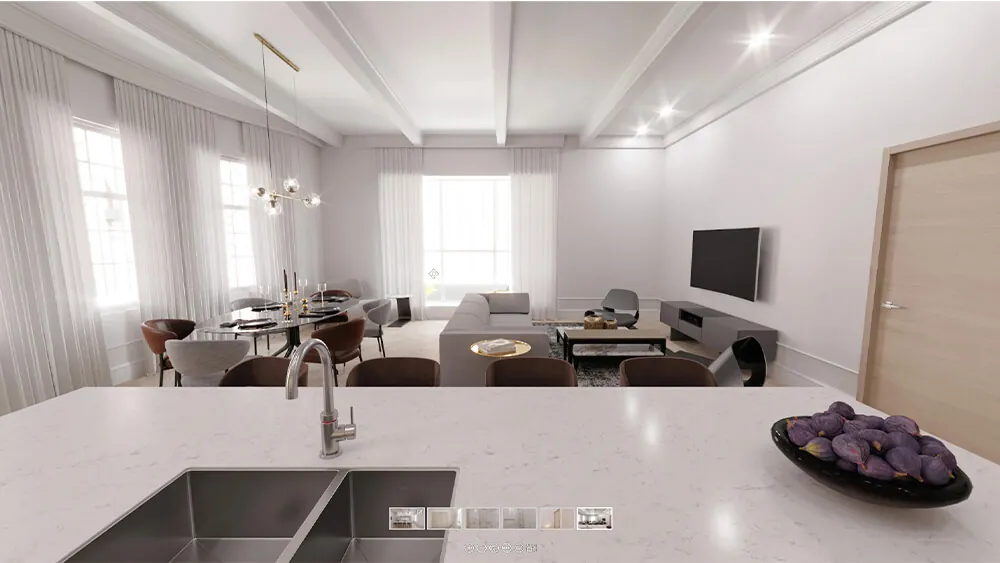
Renovation projects have a problem that new construction doesn't: the existing structure creates constraints that are difficult to visualize from drawings alone. Where will that kitchen island sit relative to the window? How will the new master bath read with the ceiling height as-is? Will the addition's exterior match the existing roofline convincingly? These questions matter enormously for a homeowner committing $80,000 to a kitchen remodel or $250,000 to a rear addition. A render answers all of them before demolition begins.
In my experience, the renovation projects that go smoothest — fewest change orders, clearest contractor communication, happiest clients — are the ones where the design was visualized in enough detail that everyone involved had the same mental picture before the first sledgehammer swing. Renders don't just show clients what they're getting; they force the design team to resolve decisions that would otherwise surface as expensive change orders mid-construction.
The Three Renovation Rendering Scenarios
Interior room remodels — kitchens, bathrooms, primary suites — are the highest-value single-space renovations and the most common use case for renovation rendering. A kitchen remodel at $60,000–$150,000 involves dozens of irreversible decisions: cabinet configuration, countertop material, backsplash, island dimensions, appliance placement, lighting layout. A render showing the completed kitchen from the cook's perspective, from the dining area, and at evening with under-cabinet lighting active lets the homeowner verify those decisions before any material is ordered. The cost of a render is typically 0.5–1% of the project budget — and it often saves multiple times that in avoided change orders.
Additions and exterior changes — second story additions, rear extensions, new garages, facade recladding — require exterior renders more than interior ones. The critical question is always: how does the addition look in context with the existing structure? A second story that looks proportional in plan can read as top-heavy in reality. A rear extension that works in elevation may conflict with the existing window rhythm. An exterior render showing the completed addition from the street and from the backyard answers these questions definitively. Provide photos of the existing structure alongside the design drawings so the studio can model the context accurately.
Full-home renovations and whole-floor reconfiguration — where walls are moved, rooms are reassigned, and the spatial organization of the home changes significantly — benefit from renders of each major space being transformed, plus an exterior render if the facade is changing. For projects at this scope, renders are typically part of the architectural design process rather than an add-on: the designer produces them as part of client approval, and they serve as the specification against which contractors price and execute the work.
The Unique Brief Challenge: Working with What Exists
Renovation renders differ from new construction renders in one critical way: the existing structure is fixed. The studio needs to accurately model the fixed elements — column locations, ceiling heights, window and door positions, structural walls — and show the new design within those constraints. This requires more information than a typical new construction brief.
What to provide for a renovation brief:
- Current floor plan with as-built dimensions (measured if no drawings exist)
- Photos of the existing space from multiple angles — the more, the better
- Design drawings showing what changes: new walls, removed walls, new layout
- Material and finish specifications for the new work
- Cabinet and fixture specifications if available, or reference images for intent
- Exterior photos from the street and relevant angles if an exterior render is in scope
- Any architectural constraints that affect the design (ceiling heights, structural elements)
The photos of the existing space are particularly important. They allow the studio to understand the fixed context — natural light direction, window proportions, the quality of the existing architecture — and show the new design accurately within that context. A render that models the fixed elements incorrectly will not serve its purpose.
Before/After Renders as a Decision Tool
One powerful application that renovation projects enable but new construction cannot: the before/after render set. Producing a photorealistic render showing the existing space alongside a render of the proposed renovation creates a direct visual comparison that is extraordinarily effective for client approval, contractor communication, and — when the project is complete — as marketing material for the design professional's portfolio.
The "before" image can be a professional photograph of the existing space. The "after" is the 3D render of the completed design. Together they communicate the transformation more clearly than either image alone. For kitchen and bathroom designers who show prospective clients their work, a portfolio built on before/after visual pairs is more persuasive than renders in isolation.
Using Renders to Get Competitive Contractor Bids
A well-produced set of renovation renders has a practical benefit that goes beyond design approval: it makes contractor bids more accurate and more competitive. When a homeowner sends three contractors a PDF of architectural drawings and asks for a price, they typically get back three bids that vary by 30–50% because each contractor interpreted the scope differently. When the same homeowner sends three contractors the drawings plus a set of renders showing exactly what the finished project should look like, the bids converge — because the scope is unambiguous.
More accurate bids benefit everyone: the homeowner gets apples-to-apples pricing, the contractors spend less time qualifying scope, and change order disputes become less common because the visual reference exists throughout construction.
Pricing and Timeline for Renovation Renders
| Render Type | Price Range | Delivery |
|---|---|---|
| Kitchen interior | $399–$800 | 4–6 days |
| Bathroom interior | $299–$600 | 3–5 days |
| Living/great room | $399–$799 | 4–6 days |
| Exterior / addition | $599–$1,200 | 5–8 days |
| Multi-room package | $1,500–$3,500 | 7–12 days |
Renovation renders are typically priced at the lower end of the interior render range because the brief is more constrained — the fixed architectural elements are given, not designed from scratch — and the scope of the 3D model is smaller than a full new-construction project.
Our interior rendering and exterior rendering services cover renovation projects at all scales. For single-family home renovation and addition rendering specifically, see our guide on single family home 3D rendering. For pricing details, see our pricing page.
Planning a Renovation?
Send us your existing plans and design drawings and we'll have a render estimate within 2 hours.
Request a Free Estimate