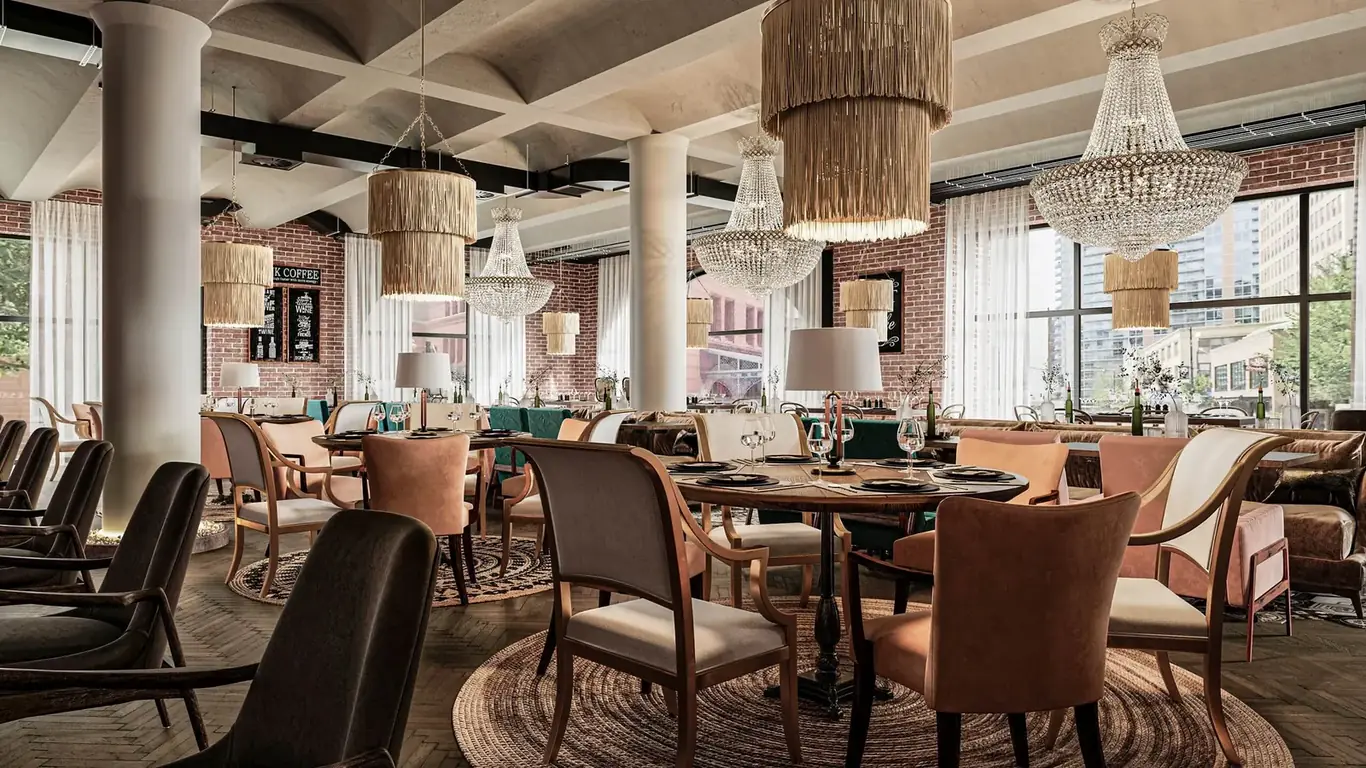
Restaurant renders occupy a distinct position in commercial visualization because the product being sold is not a building — it's an experience. A hotel lobby render needs to look impressive; a restaurant render needs to make you feel like you want to eat there at 8pm on a Saturday. The brief requirements, the lighting approach, and the elements that make a render successful are fundamentally different from standard commercial visualization.
This guide covers how visualization is used across the three main restaurant scenarios — independent new openings, franchise rollouts, and renovations — what views to commission, how lighting changes the quality equation, and what the work realistically costs.
Three Restaurant Scenarios, Three Different Briefs
New independent restaurant opening: The most common use case for independent operators is financing and lease negotiation. Banks and landlords need to see what you're proposing before committing. A set of photorealistic interior renders — the main dining room, the bar, the entry — plus an exterior facade render showing how the space will read from the street, gives investors and landlords a clear picture of the concept quality. These renders also become the anchor of the pre-opening marketing campaign: the Instagram presence, the website, the local press coverage, all built around visualized spaces before a single tile is installed.
Franchise and multi-unit rollout: For franchise operators expanding into new locations or national chains standardizing their design, visualization serves a different purpose: brand consistency verification. The brand organization needs to see that the new location matches the system standards before approving the fit-out. Renders are produced against the brand's design specifications to demonstrate compliance and get approval before construction begins — preventing costly late corrections. For franchise expansion programs opening 10–20 locations per year, the render package is produced once and reused with location-specific adjustments.
Renovation and remodel: When an existing restaurant is being redesigned, renders show the before/after contrast, help the operator commit to design decisions, and allow the team to preview how the new concept will look in an existing floorplate. Renovation renders need to accurately represent the fixed structural elements — column locations, window positions, ceiling heights — that constrain the design. Providing photos of the existing space alongside the design drawings significantly improves brief quality.
Lighting: The Critical Difference in Restaurant Rendering
Restaurant visualization is more lighting-sensitive than almost any other render type because restaurant design is more lighting-sensitive than almost any other interior type. The entire emotional tone of a dining room is set by lighting: warm pendant clusters over intimate tables read completely differently than cool gallery-style lighting over a modern counter. A render that gets the geometry and materials right but misses the lighting atmosphere fails the brief entirely.
Brief the studio explicitly on lighting intent:
- Overall ambiance: intimate/dim, bright/casual, dramatic/theatrical
- Key fixtures: pendant types, sconce locations, bar backlighting, cove or accent lighting
- Time of day: the primary render should show the space at the time it will be busiest and most atmospheric (typically evening for dinner-focused concepts)
- Natural light: how does daylight read during service hours? For lunch-heavy concepts, a daytime version may be as important as an evening render
Most restaurant renders that miss the mark do so because the lighting brief was vague. Mood boards and reference images from comparable spaces are the most useful input a designer can provide alongside the technical drawings.
What Views to Commission
For most restaurant projects, the core render set is:
Main dining room, hero angle: The most important single render — the view that communicates the concept, the atmosphere, and the design quality. Set at evening, fully staffed with lifestyle elements, showing the full dining room from the perspective a guest would see on arrival. This render does the most work: financing presentations, marketing, press, social media.
Bar area: For concepts with a meaningful bar or lounge component, the bar is the second highest-value render. It shows the back bar treatment, stool arrangement, and any distinctive lighting design. If the concept has a signature cocktail program, the bar render is often the most-shared image in pre-opening marketing.
Private dining or signature detail: A render of a private dining room, a chef's table, a distinctive booth arrangement, or a feature element (a wine wall, an open kitchen, a terrace) gives the marketing package variety and shows a dimension of the concept that the hero dining room view doesn't capture.
Exterior / facade: For street-fronted restaurants, an exterior render showing how the space reads from outside — signage, illuminated windows at evening, terrace if applicable — is important for pre-opening marketing and lease negotiations. For food-hall, hotel-restaurant, or subterranean concepts without a street face, the exterior render may be lower priority.
Virtual Tours for Restaurant Marketing
Restaurant virtual tours — 360-degree interactive walkthroughs built from the same 3D model as the still renders — have become a meaningful pre-opening marketing tool. The ability to embed a walkthrough on the restaurant's website or share it on social media before opening creates tangible buzz and allows guests to explore the space on their own terms.
Virtual tours are not appropriate for every project. They add cost and production time, and they make most sense for destination dining concepts, large format restaurants with multiple spaces to explore, or rooftop venues where the spatial experience is a primary selling point. For neighborhood casual concepts, still renders are usually sufficient.
Pricing and Timeline
| Render Type | Price Range | Delivery |
|---|---|---|
| Interior dining view | $499–$1,000 | 4–6 days |
| Bar / feature area | $449–$900 | 4–6 days |
| Exterior / facade | $599–$1,200 | 5–7 days |
| Full package (3–4 views) | $1,800–$3,500 | 7–10 days |
| 360° virtual tour | $1,200–$2,500 | 10–14 days |
Restaurant renders are typically priced in the mid-range of interior visualization because of the complexity of the lighting brief and the level of custom furniture and material specification involved. For franchise projects with multiple locations using the same template, package pricing significantly reduces the per-location cost.
What to Provide for the Brief
- Floor plan with furniture layout and dimensions
- Reflected ceiling plan showing lighting fixture locations and types
- Material finish schedule: flooring, wall finishes, millwork, tabletops
- FF&E specifications: chair types, table base style, upholstery, pendant fixtures
- Brand guidelines or concept reference images for tone and atmosphere
- Exterior elevation if an exterior render is in scope
- Signage specifications and brand colors
- For renovations: photographs of the existing space
Our interior rendering services cover food service at all scales, from fast-casual to fine dining. See the portfolio for examples of restaurant and hospitality rendering work. For hospitality projects that include restaurant spaces alongside guestrooms and lobby, see our guide on hotel and hospitality 3D rendering. For other commercial retail spaces requiring similar interior visualization — storefronts, showrooms, and branded environments — see our guide on retail store rendering. For pricing, visit our pricing page.
Designing a Restaurant Space?
Send us your floor plan and we'll scope a visualization package with pricing within 2 hours.
Request a Free Estimate